By Radu Oprea, Owner, Wolf Spirit Deck Illinois Contractor License #TGC119852 2020 Calamos Ct, Suite 200, Naperville, IL 60563 | (312) 765-3998 Last updated: August 2026
I should say this first, because it changes how you read the rest of the post. We build decks. We do not pour patios or lay pavers. So I have an obvious bias, and the useful thing I can do is tell you exactly where that bias is wrong.
There are yards in Naperville where a deck is the worse purchase. I have walked away from jobs over it. A homeowner off Ogden with a walkout that sat four inches above grade wanted a deck, and what she actually needed was a paver patio and about six hundred dollars of regrading. Building her a deck would have been taking money for the wrong thing.
So here is the comparison I give people in the driveway, with the numbers I actually quote and the ones I do not.
The thing that decides it is not taste
Most people come to this question thinking about style. Warm wood underfoot versus stone. Modern versus traditional. That is the last consideration, not the first.
The first one is how far your back door sits above the ground.
Measure from the threshold of your patio door down to the dirt. If it is under about eight inches, a patio is usually the better answer and a deck starts looking like an expensive way to solve a problem you do not have. Somewhere between eight and thirty inches, either one works and the choice comes down to budget, drainage, and what you want the space to do. Above thirty inches, a patio stops being an option unless you want to walk down a flight of stairs to reach it, and now you are in deck territory whether you like the look or not.
That single measurement settles maybe seventy percent of the conversations I have.
What each one costs in Naperville
Here is what we charge for decks. These are our real planning ranges for a standard ground level to mid height deck with railings, and they come off our own quotes rather than a national calculator.
| Deck size | Pressure treated wood | Composite (Trex / TimberTech / Deckorators) |
|---|---|---|
| 200 sq ft (10×20) | $9,000 to $14,000 | $13,000 to $20,000 |
| 300 sq ft (12×25) | $12,000 to $19,000 | $18,000 to $28,000 |
| 400 sq ft (16×25) | $16,000 to $26,000 | $24,000 to $38,000 |
| 500+ sq ft (multi level) | $22,000 and up | $34,000 and up |
Per square foot that lands around $45 to $65 for pressure treated and $60 to $95 for composite, installed.
For pavers I am not going to make up numbers. I do not write those quotes, and a hardscape contractor would rightly tear apart anything I invented. What I will tell you is the pattern I see when a homeowner shows me both bids side by side:
[INSERT YOUR OWN DATA HERE: pull 8 to 12 jobs from the last two years where the homeowner also got a paver bid. Give the deck bid, the paver bid, and the size. Even a rough table beats a generic claim, and it is the part of this post competitors cannot copy.]
The pattern, though, holds up. On a small ground level space, pavers usually come in cheaper. Once you add height, the gap closes fast, because every inch of elevation on a patio means retaining wall, fill, and compaction, and those add up quicker than joists do.
There is also a cost people forget. If your yard slopes, a patio needs the grade fixed before anything gets laid. A deck just gets longer posts. On the sloped lots near the DuPage River that difference has swung projects by five figures.
The permit rule almost nobody mentions
This is the part that surprises people, and it is genuinely useful, so read it even if you skim the rest.
Decks and patios are treated completely differently by the City of Naperville, and patios have a threshold decks do not.
For a patio, the city requires a permit once the total paved area goes over 500 square feet. Under that, and you often do not need one. But size stops mattering the second you add anything. A permanent fire pit, a fireplace, a built in grill, any electrical, plumbing, or gas, or a patio sitting more than 30 inches above the adjacent ground, and you need a permit no matter how small the thing is. Setback and easement rules still apply either way.
Decks are simpler and stricter. Any elevated deck needs a permit. So does replacing beams, joists, stairs, or railings on one you already own.
Two things follow from that. First, the “no permit needed” argument for a patio evaporates the moment somebody says the words fire pit, which in my experience is about the third sentence of most patio conversations. Second, if you were planning to skip the permit, the city catches unpermitted work at resale, and I have rebuilt enough of those to know how that conversation goes.
Permit fees on a residential deck here run roughly $400 to $600 all in. We walk through every line of it, with the city’s own fee reports, in our breakdown of the real Naperville deck permit process. Worth reading before you budget either project.
And if you live in Tall Grass, White Eagle, Ashbury, or Stillwater, your HOA is the harder gate, not the city. Both decks and patios go through architectural review, and the two get judged on different things. We wrote up what each board actually approves in our Naperville HOA deck rules guide.
Lifespan, and why Illinois is hard on one of them
Frost here pushes down about 42 inches. That number is the whole story.
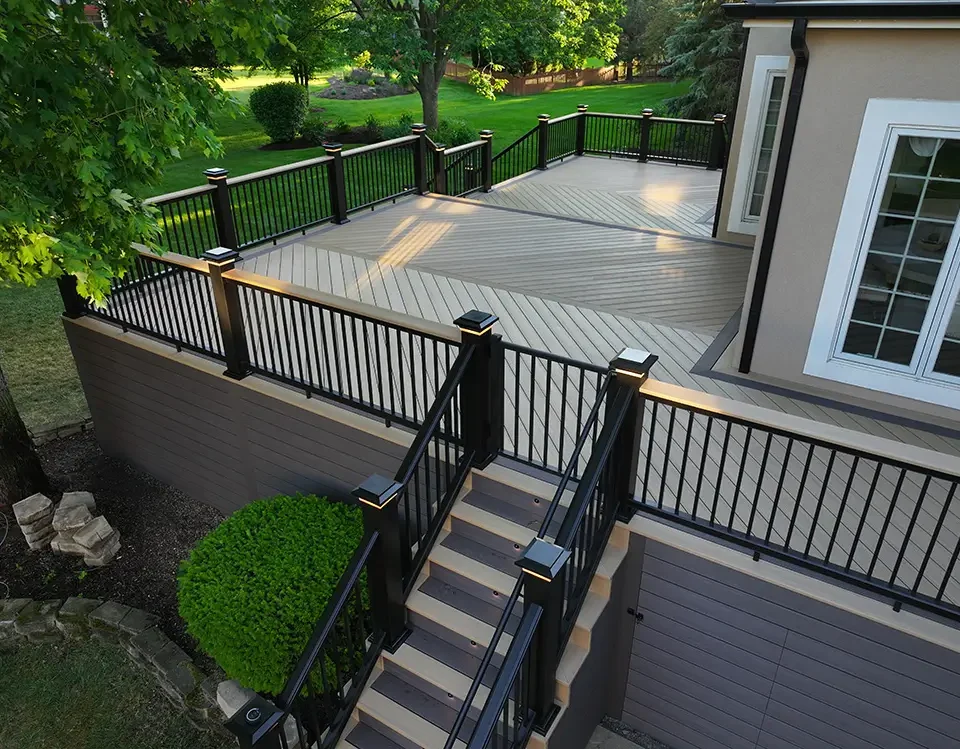
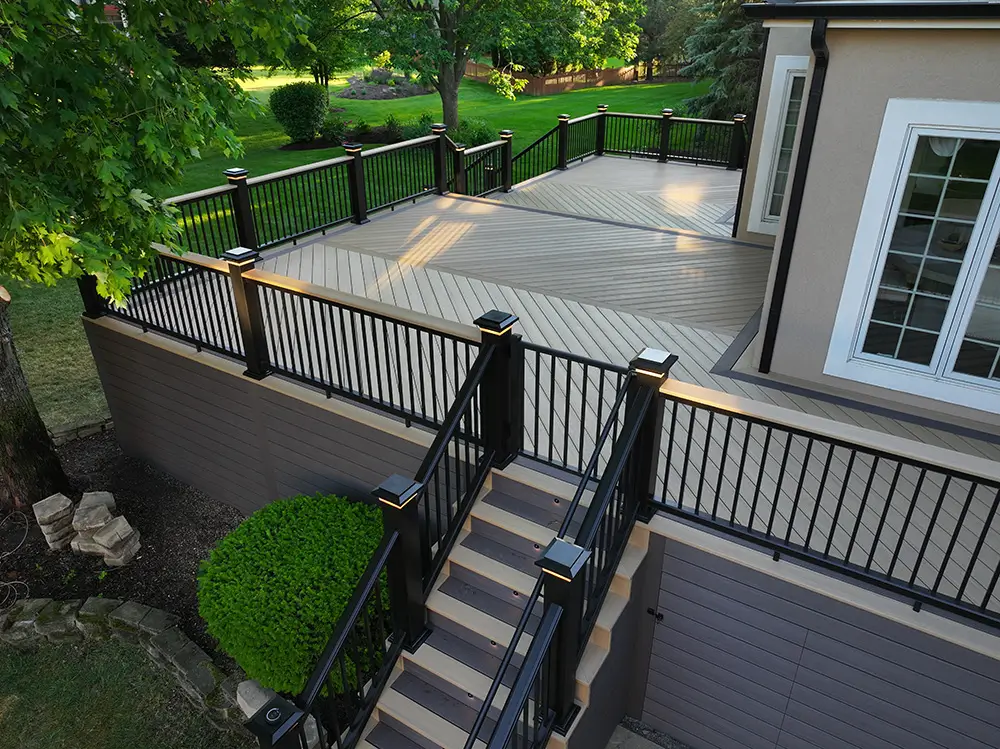
A deck deals with it by going below it. We dig footings or drive helical piles past the frost line, the structure sits on something that does not move, and the ground can do whatever it wants above. On an elevated composite deck we built in Naperville on ten steel helical piles, the yard dropped almost seven feet across the span and the deck has not shifted.
A paver patio sits on a compacted base above the frost line. It is designed to move a little and settle back. When the base is done properly, with adequate depth and real compaction and drainage that goes somewhere, it does exactly that for decades. When the base is rushed, you get the thing every Naperville homeowner has seen in a neighbor’s yard: a low spot that holds water, a few pavers riding higher than the rest, and a wobble by year four.
Rough lifespans, assuming the work was done right:
- Paver patio: 25 to 50 years for the pavers themselves, with occasional releveling. The base is what fails, not the stone.
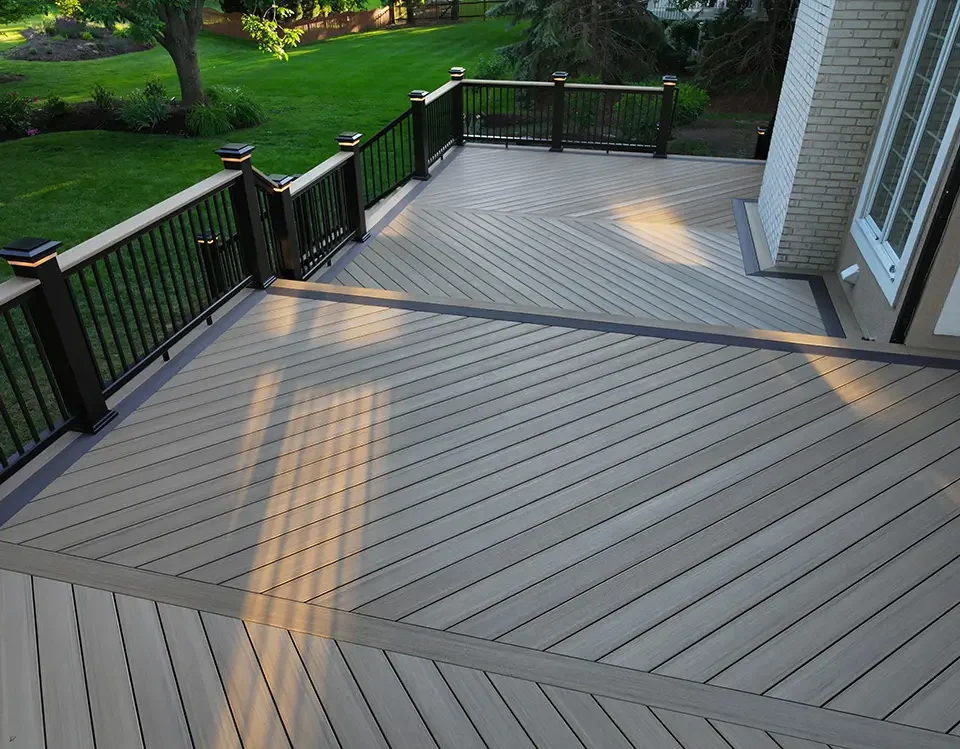
- Composite deck: 25 to 50 years on the boards, with 25 to 50 year manufacturer warranties. We inspected 21 of our own decks across the 60540, 60563, 60564, and 60565 zip codes at the five year mark and wrote up what we found in our cedar, Trex, and TimberTech comparison.
- Wood deck: 10 to 30 years, depending entirely on whether you keep up with it. Our humidity is brutal on untreated wood, which I get into in how Naperville’s climate changes the way we build.
Maintenance splits differently than people expect. Pavers need weeding, occasional resanding of joints, and releveling if the base settles. Composite needs a hose. Wood needs stain every other year, which runs about $1,200 a cycle if you hire it out.
One risk a patio simply does not have: a deck is bolted to your house. When the ledger flashing is skipped, water gets behind the siding and rots the rim joist, and you find out during a home inspection. That failure mode is real and it is expensive, and it is one of the few genuine arguments for a patio. I wrote about what we find behind old ledgers in how an old deck can rot your house.
Resale
Both help. Neither is a jackpot.
What I hear consistently from agents working Naperville is that buyers here expect usable outdoor space, so the absence of either one is a bigger negative than the presence of either is a positive. A tired wood deck two summers past its last staining shows badly in listing photos. A settled patio with weeds through the joints shows just as badly.
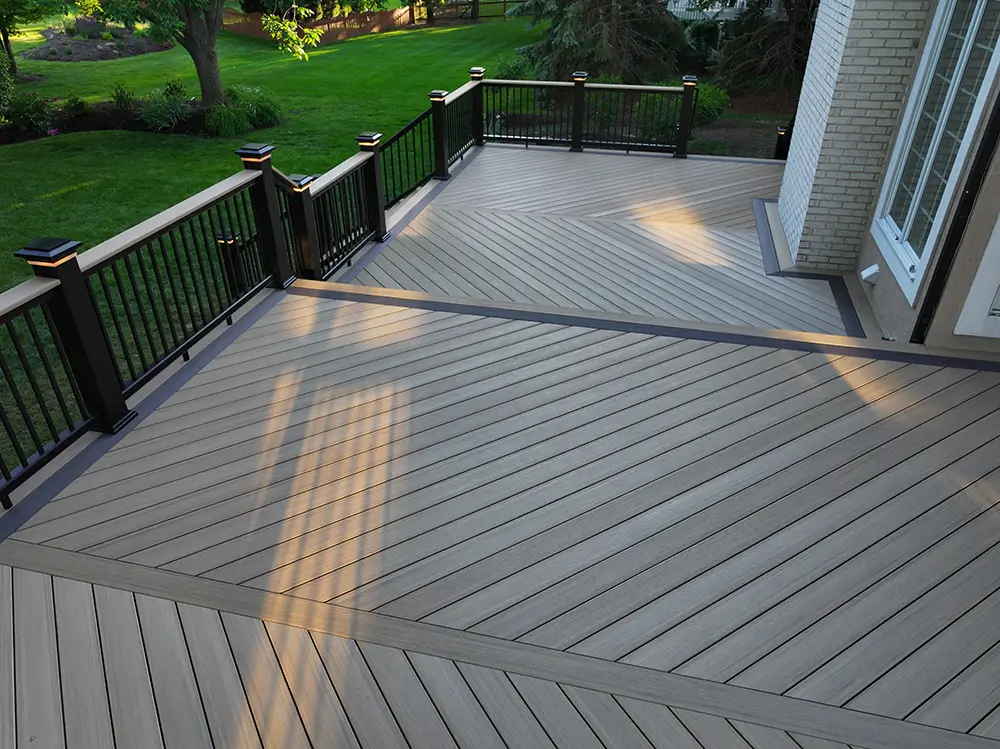
Composite tends to photograph better after a few years because it holds its color while a house sits on the market. That is a small edge, not a decisive one.
If your existing deck is structurally sound and just looks dated, do not tear it out to chase resale. Deck resurfacing runs about a third of a rebuild, and we put honest numbers on it in our 2026 resurfacing cost guide.
When I tell people to build a patio instead
Four situations, and I mean these.
Your door is nearly at grade. Under eight inches, a deck is a low platform that traps moisture underneath and looks like an afterthought. Pour the patio.
You want a fire feature as the centerpiece. Wood burning fire pits and decks do not mix, and building codes and manufacturer warranties both have opinions about it. If the fire pit is the whole point, build around it in stone.
You are furnishing it like an outdoor room with heavy pieces. Stone tables, big planters, a pizza oven. All of that is easier on a slab.
Your budget is genuinely tight and the space is small and flat. On a 200 square foot ground level space, a patio will usually cost you less, and I would rather tell you that than sell you a deck you had to stretch for.
When a deck is the only honest answer
Your walkout is more than thirty inches up. Everything else is theater at that point.
Your lot slopes hard. Filling and retaining a sloped yard for a patio costs more than framing over it, and it changes how water moves across your property in ways you may regret. This is where steel deck framing earns its cost.
You need the space over a septic field, tree roots, or a utility easement. A deck can span. A patio cannot.
You want lighting, a hot tub, or a roof integrated into it. Deck lighting and structural loads are far simpler when there is framing to work with.
The answer for a lot of Naperville yards is both
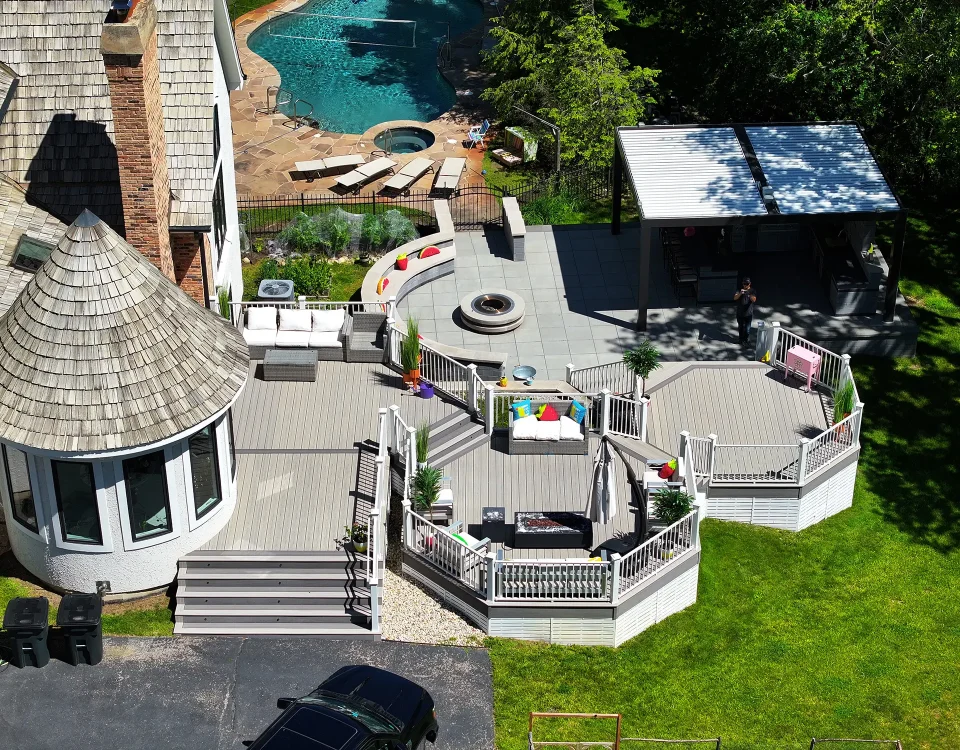
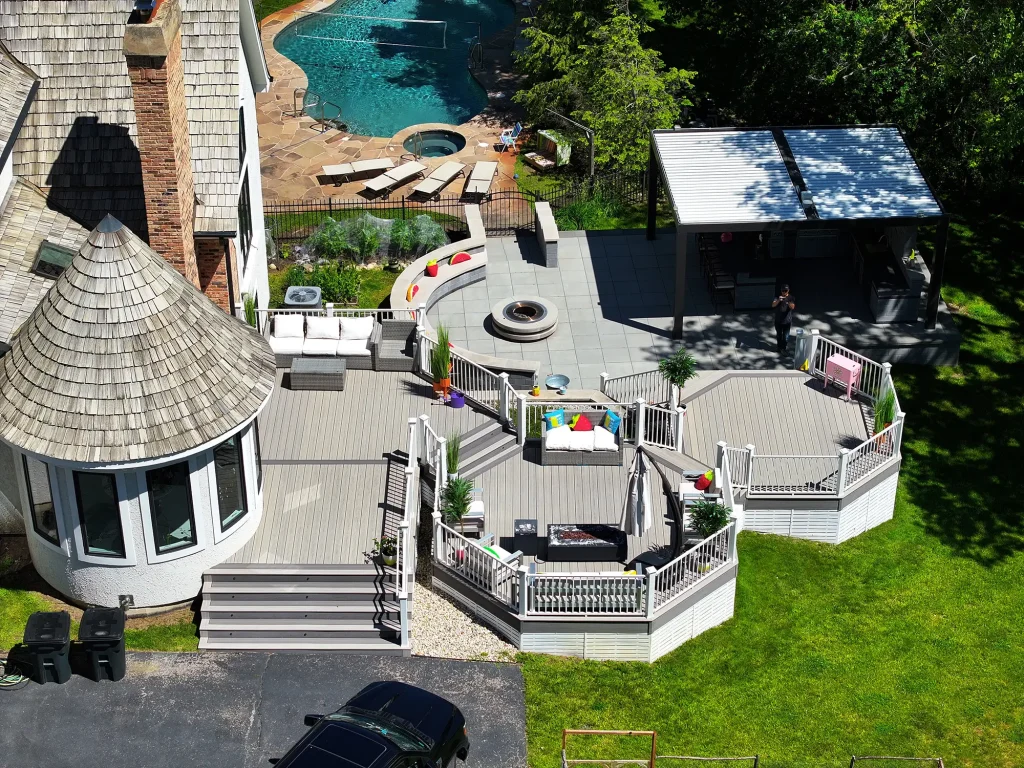
The build I recommend most on lots with a real elevation change is not one or the other. It is a deck off the door at the height of the house, stairs down, and a paver patio at grade for the fire pit and the dining table.
You get the walkout connection without stairs at the kitchen door, and you get the stone surface where the fire and the heavy furniture live. We frame and build the deck, and you bring in a hardscaper for the patio. I will happily coordinate schedules with them, and I would rather do that than talk you into a deck doing a job it is bad at.
Add a motorized louvered pergola over the deck portion and you have shade on the part you use at 2 p.m. in July, which is the single most common regret I hear about finished outdoor spaces around here.
Common questions
Is a paver patio cheaper than a deck in Naperville? On a small, flat, ground level space, usually yes. Once your yard slopes or your door sits more than a couple of feet above grade, the retaining and fill work on a patio closes the gap and often passes a deck. Get both bids on the same square footage before you assume.
Do I need a permit for a paver patio in Naperville? Only if the total paved area exceeds 500 square feet, or if the design includes a permanent fire pit, fireplace, grill, electrical, plumbing, or gas, or sits more than 30 inches above the adjacent ground. Setback and easement rules apply regardless of size.
Do I need a permit for a deck in Naperville? Yes, for any elevated deck, and for replacing beams, joists, stairs, or railings on an existing one. Swapping boards on a sound frame is resurfacing and generally does not need one. Plan review takes two to four weeks.
Which lasts longer in Illinois weather? Both can run 25 to 50 years. A composite deck’s footings go below the 42 inch frost line, so freeze and thaw does not move it. A patio sits above the frost line and depends entirely on how well the base was compacted and drained. Bad base work is the most common patio failure I see around here.
Which adds more at resale in Naperville? Neither one dramatically. Having usable outdoor space matters more than which kind it is. Composite tends to show better in listing photos after a few years because it holds its color.
Can I put a fire pit on a composite deck? Only a self contained, properly rated propane or gas unit on a protective mat, and you should check the board manufacturer’s warranty language first. Wood burning fire pits belong on stone.
Talk it through with someone who will tell you no
We are at 2020 Calamos Ct, Suite 200, Naperville, IL 60563, off Diehl Road, and most of our jobs are within twenty minutes of that address. We cover the 60540, 60563, 60564, and 60565 zip codes plus Lisle, Aurora, Downers Grove, Oswego, and the rest of the western suburbs we serve.
Come out for a free on site quote and I will measure your threshold height and tell you honestly which one your yard wants. If it is a patio, I will say so and point you at someone good.
Call (312) 765-3998 or request a quote.
More on what we build: composite decks, wood decks, and our full deck builder services in Naperville.