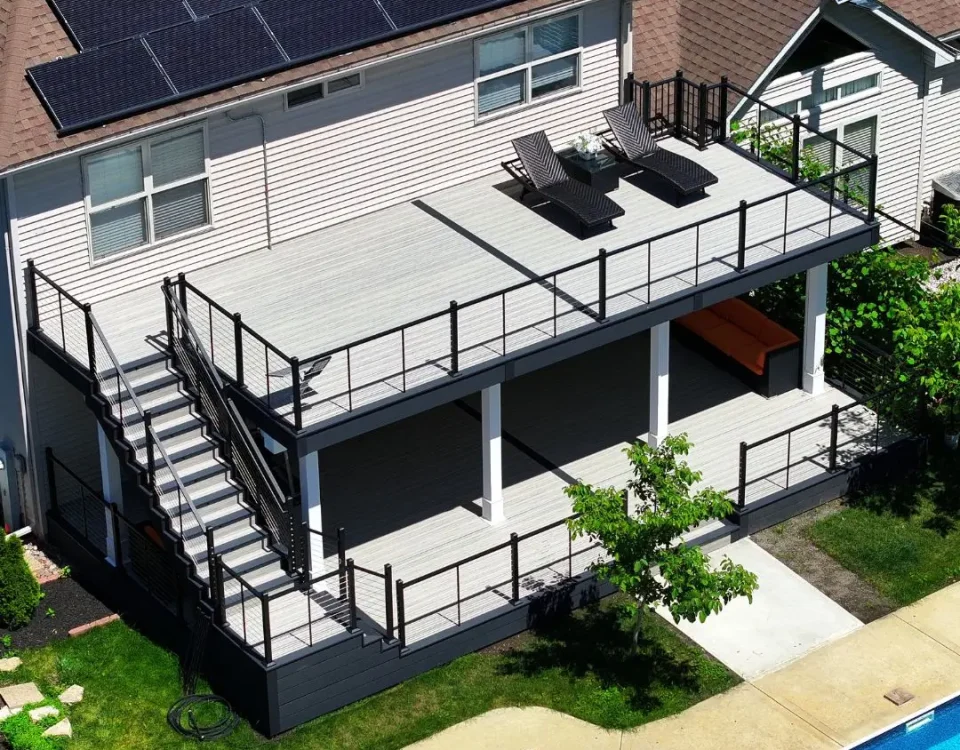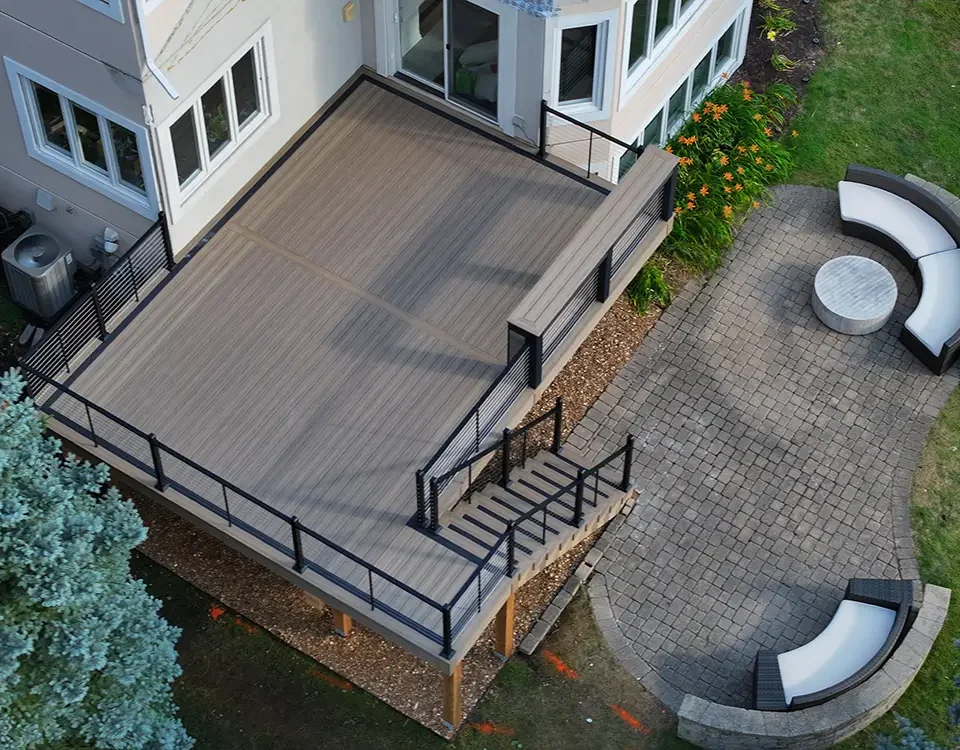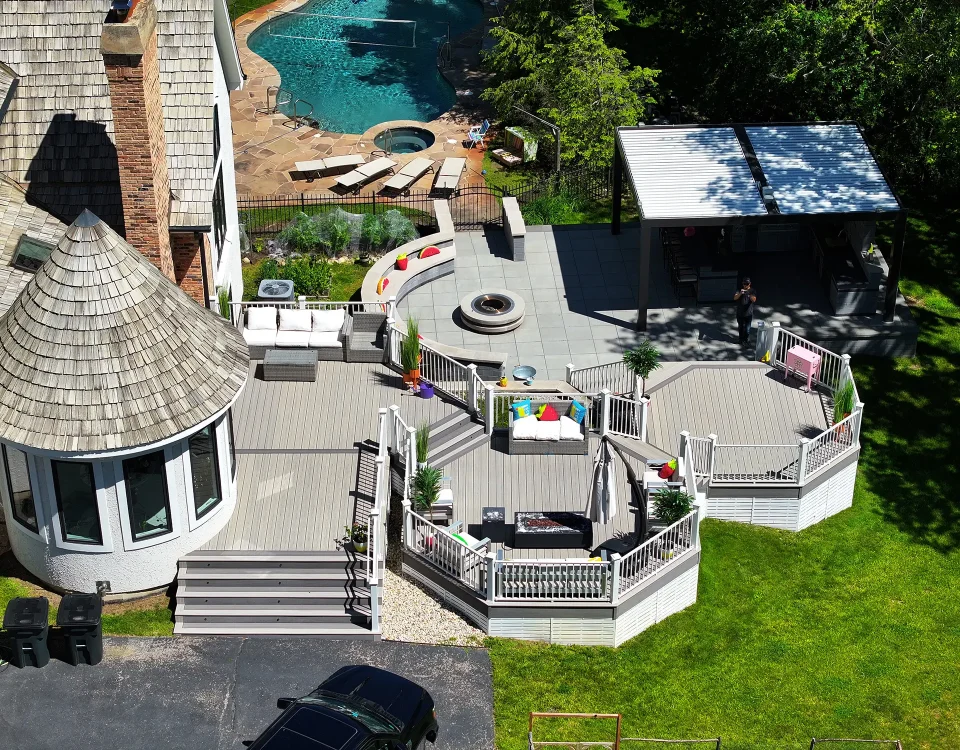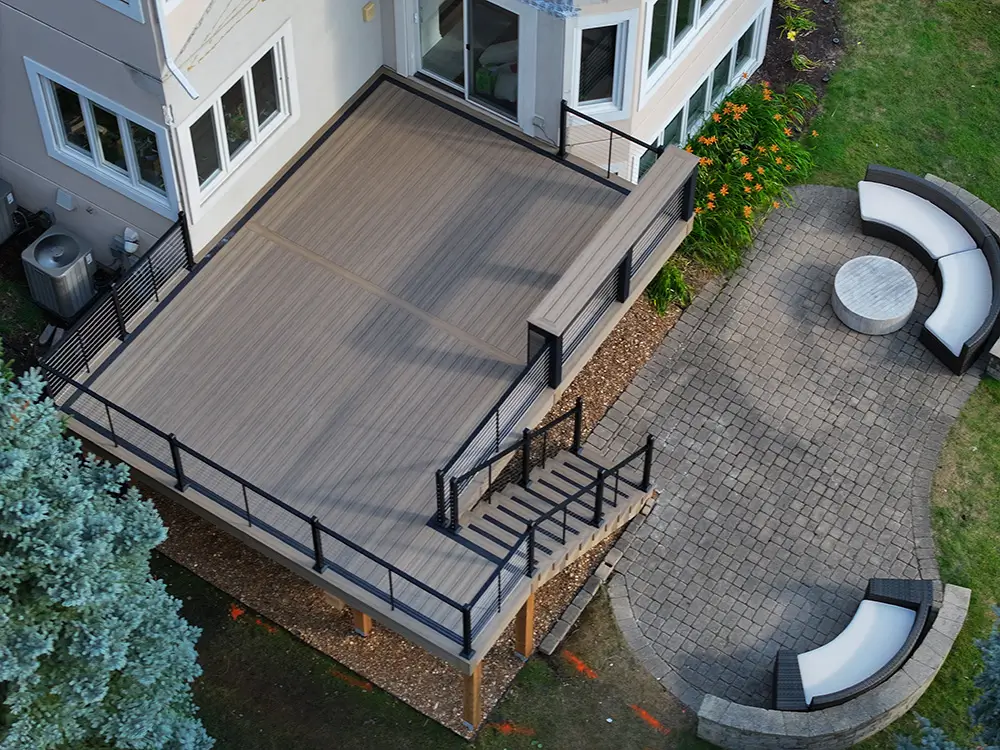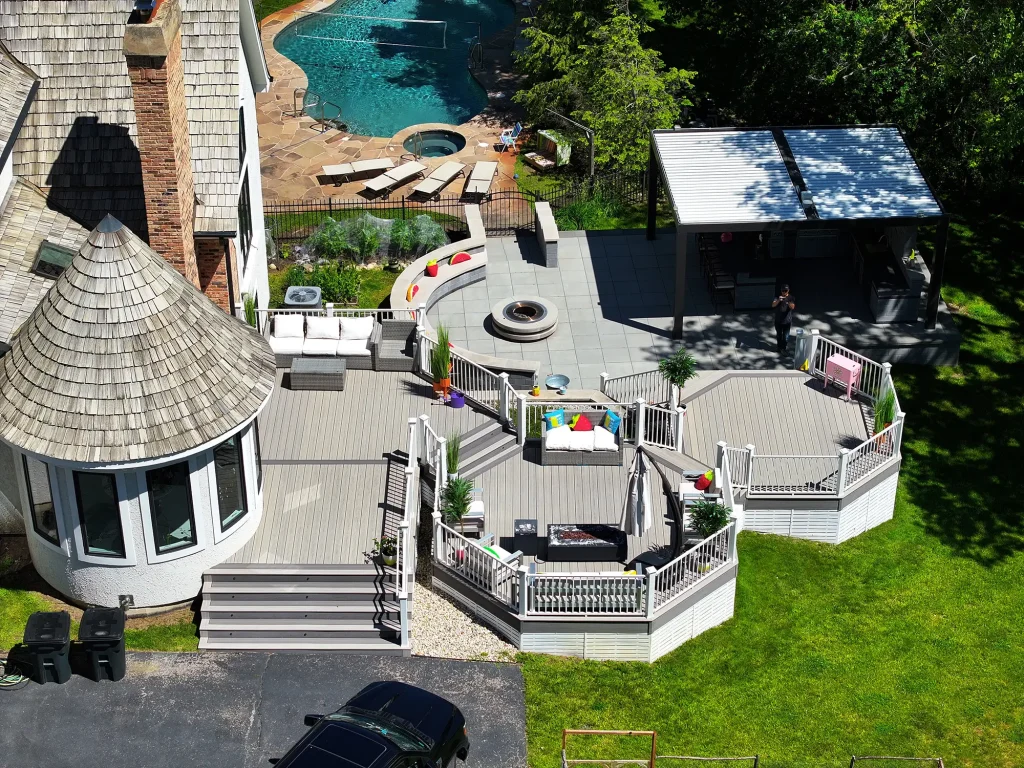
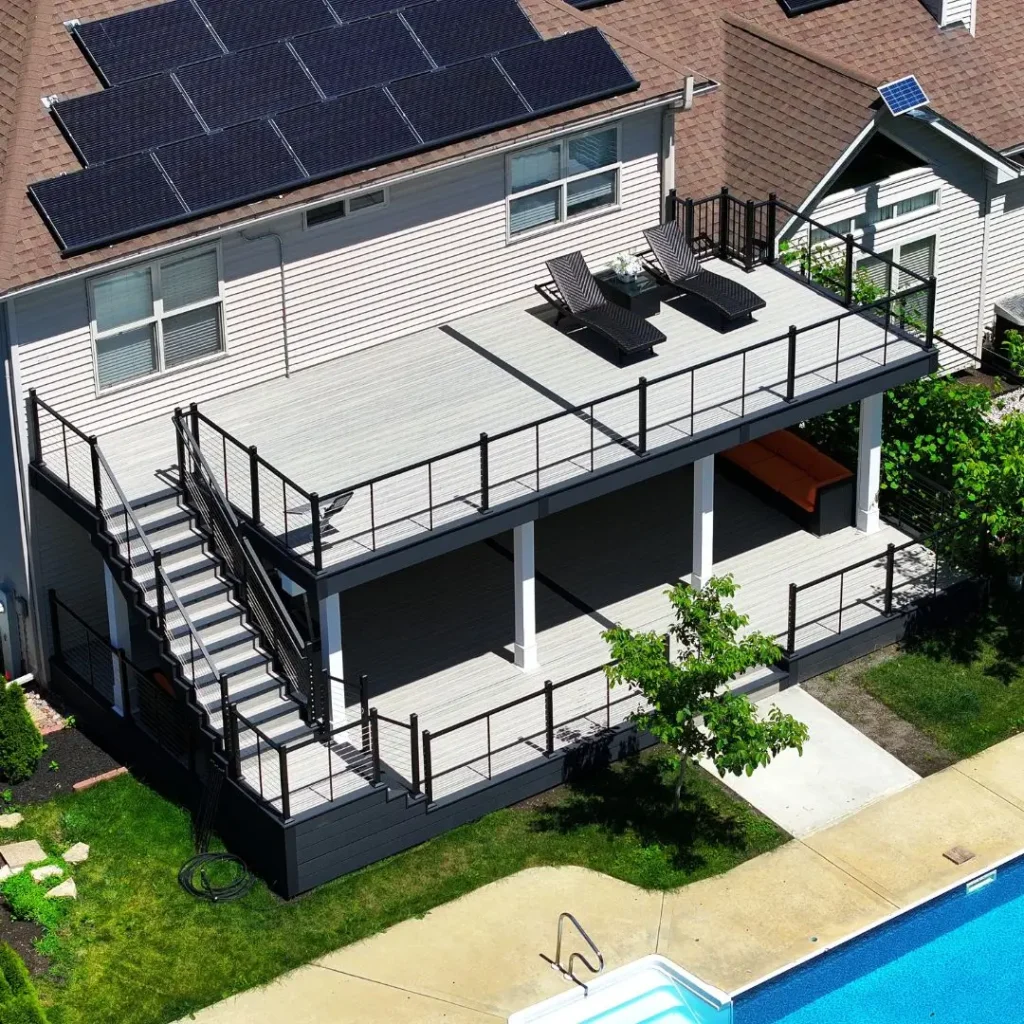
Two Naperville homeowners called us the same week last spring. Both wanted a 16×25 composite deck off the back of the house. Same size, same board, same railing. One quote came back a little over $28,000. The other was closer to $37,000.
Neither of them was being overcharged. The houses were about nine miles apart, and almost everything that made the second deck cost more had nothing to do with the deck itself.
People assume a deck is priced by the square foot, like carpet. It isn’t. Roughly a third of what you pay covers things that happen before a single board goes down: getting equipment into the yard, digging footings deep enough for the soil you have, and dealing with whatever the original builder left behind. Those three things change a lot depending on which part of Naperville you live in.
First, a caveat about ZIP codes
ZIP boundaries were drawn by the post office, not by anyone thinking about construction. They don’t follow subdivision lines and they don’t follow the year houses were built. There are 1970s ranches in 60564 and brand new infill houses in 60540.
So treat this as a rough map, not a rule. What we’re really describing is four patterns we see over and over, and those patterns happen to cluster by ZIP because Naperville grew outward in waves.
60540: old lots, big trees, no way in
This is central and west Naperville, including downtown and the historic district. The housing stock runs older than anywhere else in the city, and that shapes almost every line on the estimate.
The single biggest cost driver here is access. Side yards are narrow, mature oaks and maples sit right where we’d want to bring a skid steer through, and a lot of these lots have a fence, a gate, and an air conditioner condenser lined up in the only opening. When we can’t get equipment into the backyard, footings get dug by hand and every yard of concrete gets wheelbarrowed in. That’s usually one to two extra days of labor.
Older framing adds to it. If we’re replacing a deck built in the 1980s, we often find a ledger board nailed straight to the sheathing with no flashing behind it, which means opening up siding and repairing whatever rotted underneath. We wrote about how that failure spreads in how an old deck can rot your house in Naperville, because it’s the most expensive surprise a homeowner in this ZIP can run into.
If your house sits in the historic district, plan for extra review time before anything gets built. The city treats work in that area differently, and it’s worth calling before you finalize a design.
60563: north Naperville, and the cedar deck generation
North of Ogden along the Diehl Road and Route 59 corridor, most of the housing went up between the late 1970s and the early 1990s. Our own office is up here at 2020 Calamos Court, so this is the area we drive through most days.
Access is generally easier than downtown. Lots are more regular, side yards are wider, and we can usually get a machine into the backyard without taking a fence apart.
The complication in 60563 is what’s already standing. This part of town is full of original cedar decks that are now thirty to forty years old. Sometimes the framing under them is fine and we can pull the old boards and lay composite on the existing structure, which runs about a third of the cost of a rebuild. Sometimes the joists are spaced 24 inches on center, which most composite boards won’t span, and the whole thing has to come down. That single question moves a project by ten thousand dollars or more, and you can’t answer it from a photo. We laid out how we check it in our guide to composite joist spacing in Naperville.
Cress Creek and a few other neighborhoods up here also have architectural review, though it tends to be less involved than what you’ll hit further south.
60564: the newest houses, and the strictest HOAs
Southwest Naperville, south of 95th Street, includes Tall Grass, White Eagle and Ashbury. Most of it went up in the 1990s and 2000s, and part of it sits in Will County rather than DuPage.
The houses are newer, so we almost never find rotten ledgers or undersized framing. That saves money. Two other things give it back.
The first is grade. A lot of these subdivisions were built on graded farmland with walkout and lookout basements, which means the back of the house sits well above the yard. A deck that starts eight or ten feet off the ground needs larger posts, deeper footings, more stairs, and guardrails on every side. Height costs more than width, every time.
The second is the HOA. The architectural review committees in this part of town are the most demanding in Naperville. We’ve seen submissions rejected over board color, railing style, and stair placement relative to a neighbor’s sight line. Two of the neighborhoods here require you to submit before you apply to the city, which means a serial process rather than a parallel one. That’s schedule, not money, but a delayed spring build can push you into a busier season. We collected the common rejection reasons in our post on Naperville HOA deck rejections, and the neighborhood specifics in Naperville HOA deck rules for Tall Grass, White Eagle and more.
If your lot is on a corner, add another layer. Corner lots have two front yards as far as zoning is concerned, and the setbacks catch people off guard. That’s covered in our breakdown of Naperville corner lot deck setbacks.
60565: the river side of town
Southeast Naperville runs toward the DuPage River and includes Saybrook, Hobson and the Springbrook area. Housing here is mixed, mostly 1970s through 1990s.
What makes this ZIP different is what’s under the yard. Ground closer to the river holds water differently, and on some of these lots we’re going deeper than the standard 42-inch frost depth to reach soil that will actually carry the load. On a few properties we’ve used helical piles instead of poured footings. That’s a real cost difference, and it isn’t something you can predict from an address alone. We compared what we’ve found on either side of town in DuPage River vs. Ogden Avenue deck footings.
Drainage matters here too. If water already pools against your foundation, a deck built over that spot will trap it and slow evaporation, so we’d rather fix the grade first than build over a problem.
What actually moves the number
Strip the geography away and the same handful of variables keep showing up.
Height above grade is the big one. Every foot up adds framing, stairs and railing, so a ground-level deck and an elevated one of identical size can land twenty percent apart. Access is close behind. If we can drive to the back of the house we save days, and if we’re carrying everything through a 36-inch gate we don’t.
Then there’s whatever we find when we open things up. A ledger that was never flashed. A rim joist that’s gone soft. A post buried in soil instead of sitting on a footing. We inspect before quoting, but some of it only surfaces during demolition, which is why an honest estimate says what happens if we find it.
Soil and footing depth belong on the list too, for the reasons described above.
Materials and extras finish it off. Railing choice by itself swings a project several thousand dollars. Lighting, built-in seating and a pergola each add real money on top. If you’re weighing boards, our five-year comparison of cedar, Trex and TimberTech in Naperville is based on decks we built and went back to look at years later.
What doesn’t change by ZIP
Plenty stays the same no matter where you live in town. The permit process is identical citywide, handled through the city’s Civic Access portal, and you can read the requirements yourself on the City of Naperville deck and patio permit page. The building code is the same. Our labor rate is the same. We don’t price by neighborhood income, and if a contractor’s number moves because of your address rather than your yard, that’s worth asking about.
Planning ranges
These are the ranges we’ve been quoting around Naperville for composite decks with railings, assuming ground level to mid height. High decks, lots of stairs, lighting and built-ins push above these. Simple layouts close to grade come in under.
| Deck size | Approximate installed cost |
|---|---|
| 200 sq ft (10×20) | $15,000 to $22,000 |
| 300 sq ft (12×25) | $20,000 to $30,000 |
| 400 sq ft (16×25) | $26,000 to $40,000 |
| 500+ sq ft (multi-level) | $36,000 and up |
There’s no stock deck to order at a fixed price. Every one gets priced after we walk the yard. For a fuller breakdown see how much a new deck costs in Naperville, or what a 20×20 deck runs here if you have a specific size in mind.
Comparing quotes when you live in an expensive ZIP
If you’re in 60564 with a walkout and you get three quotes that vary wildly, the cheap one is usually cheap for a reason. Ask each contractor what footing depth they’ve specified, what post size, and whether the price includes the HOA submission. A bid that assumes a standard 42-inch footing on a lot that needs more isn’t a better deal. It’s a change order waiting to happen.
We put three real Naperville quotes side by side in why a $19,000 bid beat a $35,000 one, which shows what the differences usually come down to.
Common questions
Does my ZIP code affect my permit fee? No. Naperville charges the same fee schedule citywide. What varies is review time, mostly depending on whether your project touches easements, floodplain or the historic district.
I’m in 60564 and my neighbor in 60540 paid less for a bigger deck. How? Most likely theirs sat close to grade and yours doesn’t. A ground-level deck skips the stairs, the guardrails and the larger posts. Height is the most expensive variable in deck building.
Is part of Naperville in Will County? Yes. The southwest portion, largely in 60564, sits in Will County. City permits still go through Naperville, but county records and some tax questions route differently.
Can I resurface instead of rebuilding? Sometimes. It depends on the condition of the framing and the joist spacing, which is why we inspect the substructure before quoting. When it works it runs about a third of a full rebuild. Details are in our deck resurfacing page.
How long does a Naperville deck take? Most builds run one to two weeks on site, with permitting ahead of that. Here’s the full timeline.
Getting a number for your lot
The only way to know what your deck costs is to have someone stand in your backyard and look at the grade, the access and whatever is already there. We do that for free and we’ll tell you if resurfacing makes more sense than rebuilding, even though it’s the smaller job.
Wolf Spirit Deck 2020 Calamos Ct, Suite 200, Naperville, IL 60563 (312) 765-3998 [email protected] Monday to Friday 7:00 AM to 8:00 PM, Saturday 9:00 AM to 6:00 PM, Sunday 9:00 AM to 5:00 PM
We build across 60540, 60563, 60564 and 60565, including Tall Grass, White Eagle, Ashbury, Cress Creek, Saybrook and the neighborhoods along the DuPage River.
Request a quote or read more about our deck building work in Naperville.