By Radu Oprea, Owner & CEO, Wolf Spirit Deck · License #TGC119852 · Updated November 2026
A typical deck can carry a small barrel sauna if the framing under it is set up for the way a barrel sits. The cold plunge is the one that catches people off guard. It’s a fraction of the sauna’s size, but per square foot it puts down close to what a hot tub does, and an ordinary deck isn’t framed for that.
Weight is only part of it. A sauna and a plunge also bring heat and a steady supply of water onto a surface you want to last 25 years, plus two dedicated electrical circuits and a permit application with the Village. Each of those is easy to handle while the deck is being framed and expensive to fix once the boards are down, so we sort them out before the first footing goes in.
[Image 1]
What a standard deck is designed to hold
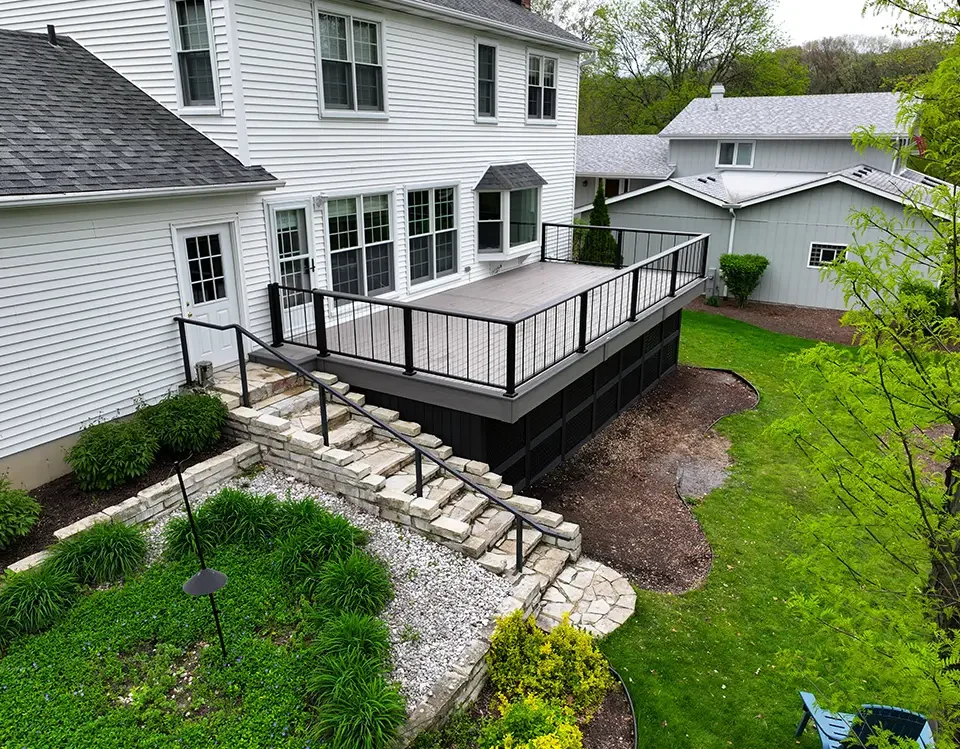
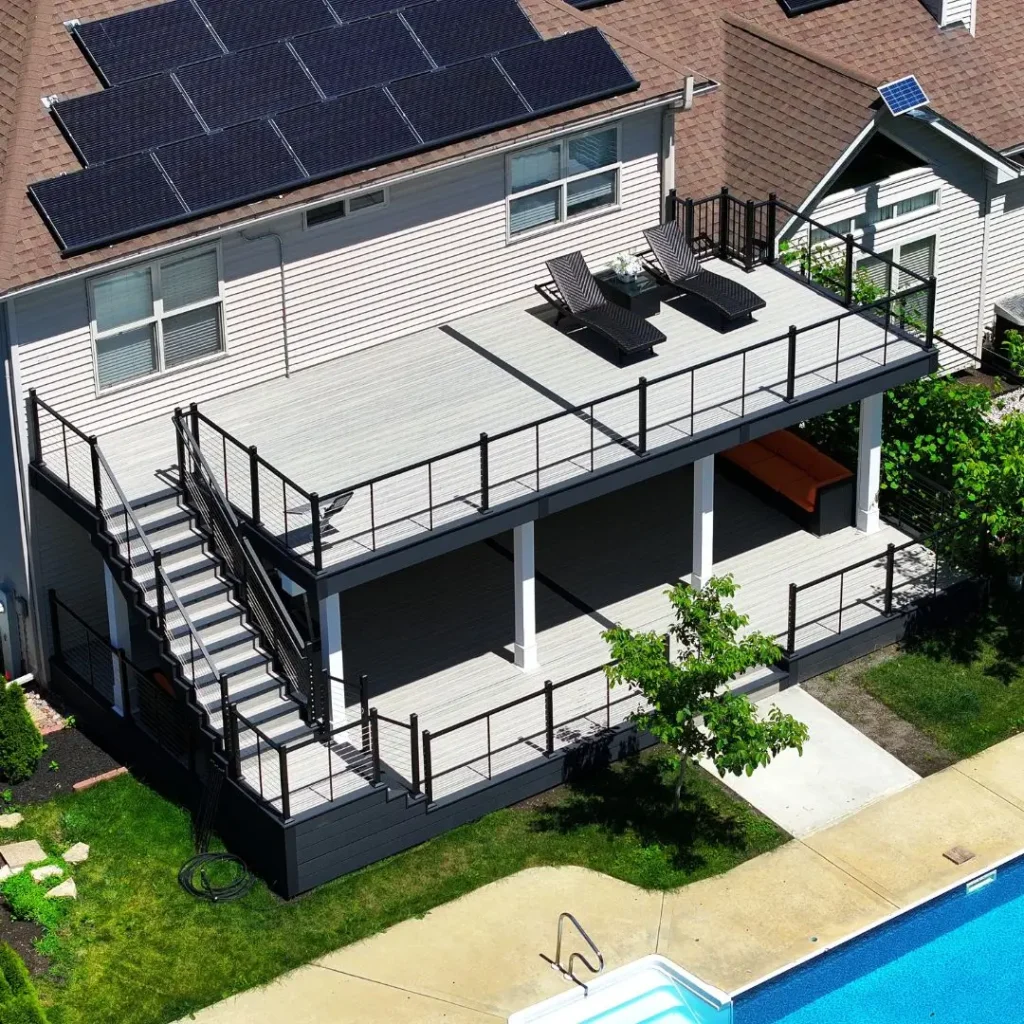
Decks built from the International Residential Code tables are sized for 50 pounds per square foot: 40 pounds of live load for people and furniture, and 10 pounds for the deck’s own weight. Every joist size, beam span, post, and footing on a code-table deck traces back to that number.
Fifty psf is plenty for a graduation party. It was never meant for a heavy object that sits in one spot for years, and saunas and plunges are exactly that. We ran the full pier and footing math for the heaviest version of this problem in our post on whether a deck can hold a hot tub, and the same approach works here at a smaller scale.
Barrel sauna weight: the total is fine, the cradles are the problem
Barrel saunas are lighter than most people guess. Manufacturer specs for four-person barrels run from about 480 to 700 pounds assembled, and a few heavier lines go past 1,300 pounds. Add four adults at around 175 pounds each and a typical setup lands between 1,200 and 1,400 pounds.
Spread over a footprint of roughly 6 by 6 feet, that’s 33 to 39 psf. On paper a normal deck handles it.
A barrel never spreads its weight over 36 square feet, though. It sits on two or three curved cradles a few inches wide, so the whole load comes down along a few narrow lines. If the cradles run the same direction as the joists, one cradle can end up resting on a single joist, or on deck boards between two joists. Composite boards are rated to span between joists under foot traffic. Holding up one side of a sauna by themselves is outside that rating.
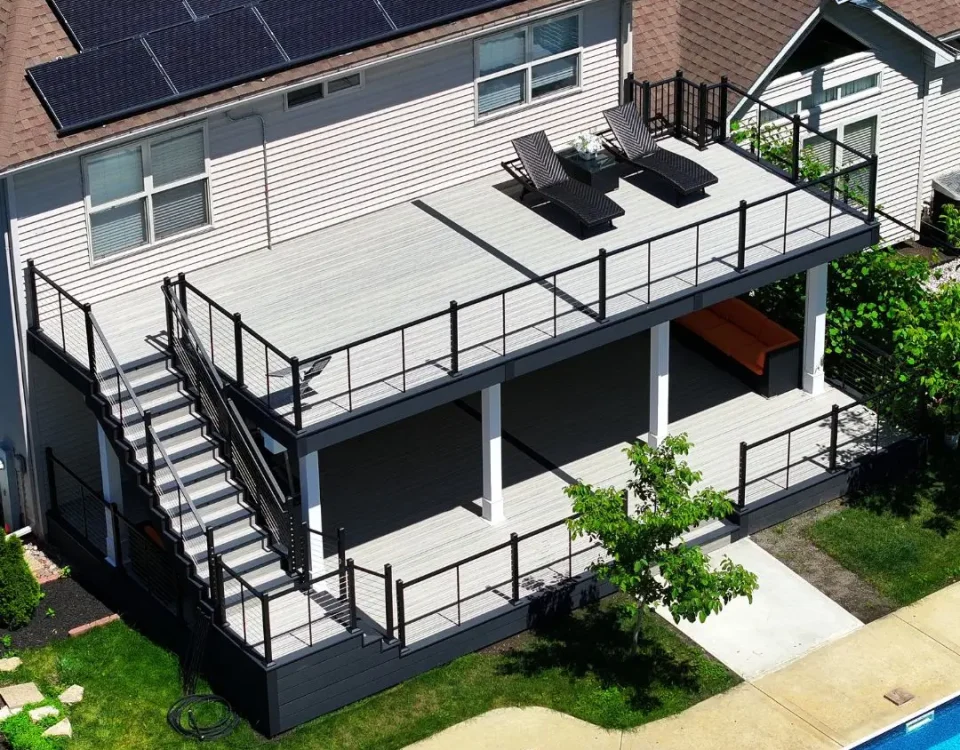
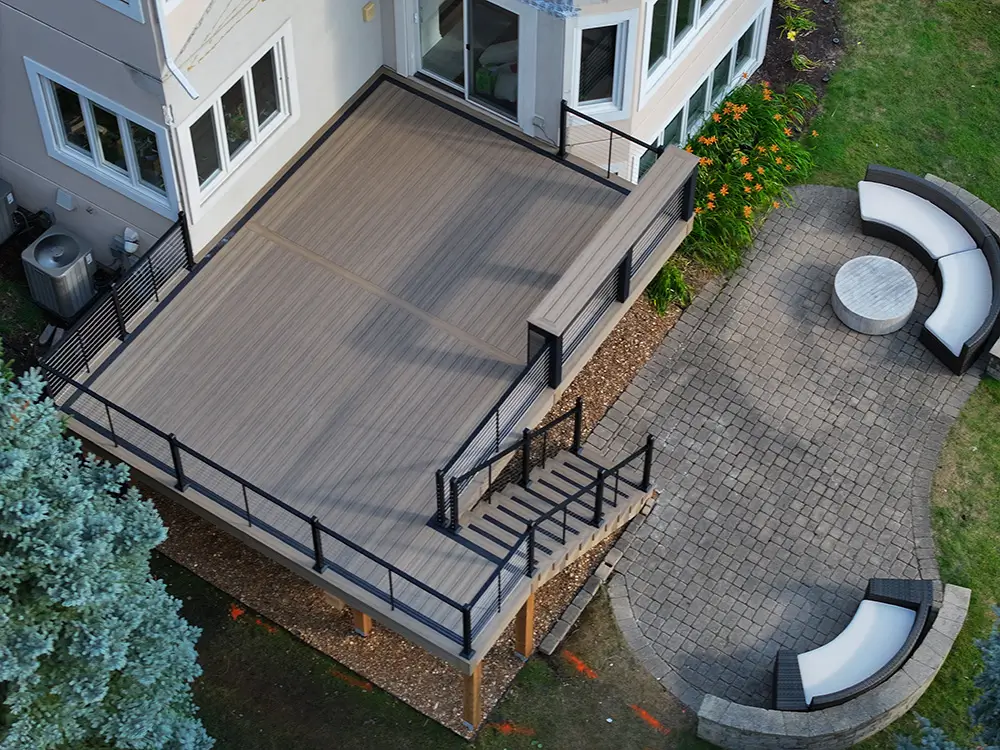
The fix is easy to build in during framing. We turn the sauna so the cradles cross the joists at a right angle, which puts each cradle across four or five joists instead of one. Then we add solid blocking between the joists under each cradle line and tighten the joist spacing in the sauna zone. On an existing deck, the same fix usually means pulling a few rows of boards first.
Read spec sheets carefully. Some give shipping weight instead of assembled weight, and some leave out the heater. Cabin-style saunas can weigh more than a barrel with the same seat count, although their flat floor frame spreads the load more evenly. Plan around the assembled weight with the heater installed, for the exact model you’re buying.
[Image 2]
Cold plunge weight: small tub, big number per square foot
Water weighs about 8.34 pounds per gallon, so 100 gallons is roughly 834 pounds before you count the tub. One 115-gallon plunge on the market lists a filled weight of 1,050 pounds. Put a 200-pound adult in it and you’re at 1,250.
Most single-person tubs take up about 5 by 3 feet, or 15 square feet. That works out to around 83 psf. A larger 128-gallon model listed at 1,600 pounds filled goes past 100 psf on a similar footprint. Both are well beyond the 50 psf the deck was designed around, and the load sits in a space about the size of a loveseat.
| What’s on the deck | Loaded weight (approx.) | Footprint | Load per sq ft |
|---|---|---|---|
| Standard deck design load | n/a | n/a | 50 psf (40 live + 10 dead) |
| 4-person barrel sauna with 4 adults | 1,200 to 1,400 lbs | about 36 sq ft | 33 to 39 psf average, concentrated at the cradles |
| 115-gallon cold plunge with 1 adult | about 1,250 lbs | about 15 sq ft | about 83 psf |
| Mid-size hot tub with 6 adults | about 5,300 lbs | 49 sq ft | about 110 psf |
We frame a plunge zone like a small hot tub pad. That means deeper joists at 12 inches on center with blocking, a doubled or tripled beam on shorter spans, and extra footings under that area. In Burr Ridge every footing goes 42 inches below grade to get under the frost line. Once a design goes past what the prescriptive code tables cover, the plan reviewer will usually want an engineered design, so we build that time into the schedule.
Steel framing is worth pricing for a plunge zone. Steel joists carry concentrated loads with less depth, and they won’t rot under a spot that gets splashed every day. Our steel deck framing page covers the systems we install.
Some clients prefer to recess the plunge so its rim sits close to deck height. The tub then gets its own footings and framing below the deck surface, which carries the load directly and means you step down into the water instead of climbing over a tall rim. That has to be decided before framing starts, and not every tub is designed to be set in, so check with the manufacturer first.
Heat: what actually gets hot
With an electric heater, the deck under a sauna sees less heat than people expect. The sauna has its own floor, the heater is mounted at the clearances its manual specifies, and hot air rises.
Wood-fired sauna stoves are the main heat risk for a composite deck. Embers can drift out of the chimney, and the ash pan has to be emptied somewhere, usually by someone in a towel who wants to get back inside quickly. Trex says its boards can start to soften at temperatures as low as 176°F, and composite warranties generally exclude heat damage. Our post on fire pits and Solo Stoves on composite decking explains how that plays out, and a wood stove’s ash follows the same rules.
For a sauna that sits on the deck, we recommend an electric heater. If you’re set on wood, follow the stove maker’s clearances to combustibles, use a non-combustible hearth pad wherever the manual calls for one, fit a spark arrestor on the chimney, and keep a lidded metal ash can on concrete or pavers off the deck. Keep the chimney well away from the house and from anything overhead, like pergola louvers or a roof overhang.
Infrared saunas run much cooler than traditional ones and usually weigh less, which makes them the easiest type to put on a deck.
Water: where it goes after every session
A traditional sauna is wet. Water ladled onto the stones drips through the floor slats, and many barrel saunas have a drain hole at the lowest point that lets it out onto whatever is underneath. If the sauna sits on a solid rubber mat or a flat pad, that water stays trapped against the boards in permanent shade, and mildew and staining build up where you can’t reach to clean.
We leave airflow under the cradles, keep the board gaps below the sauna open, and line the drain hole up over a gap so water drops straight through to the ground. The ground under that spot should slope away from the house. On walk-out lots, which we see a lot of in Burr Ridge, we also make sure it isn’t draining onto the lower patio.
A plunge brings more water than a sauna. Every use pushes water over the rim, and it drips across the deck on the way out. Depending on the sanitation system, you’ll also drain and refill the tub every so often, which means releasing 100-plus gallons at once. Plan a hose route for that before the deck is built, and send it somewhere that won’t flood a window well or wash out a planting bed. If you treat the water with a sanitizer such as chlorine or bromine, check the product label before draining it into the yard.
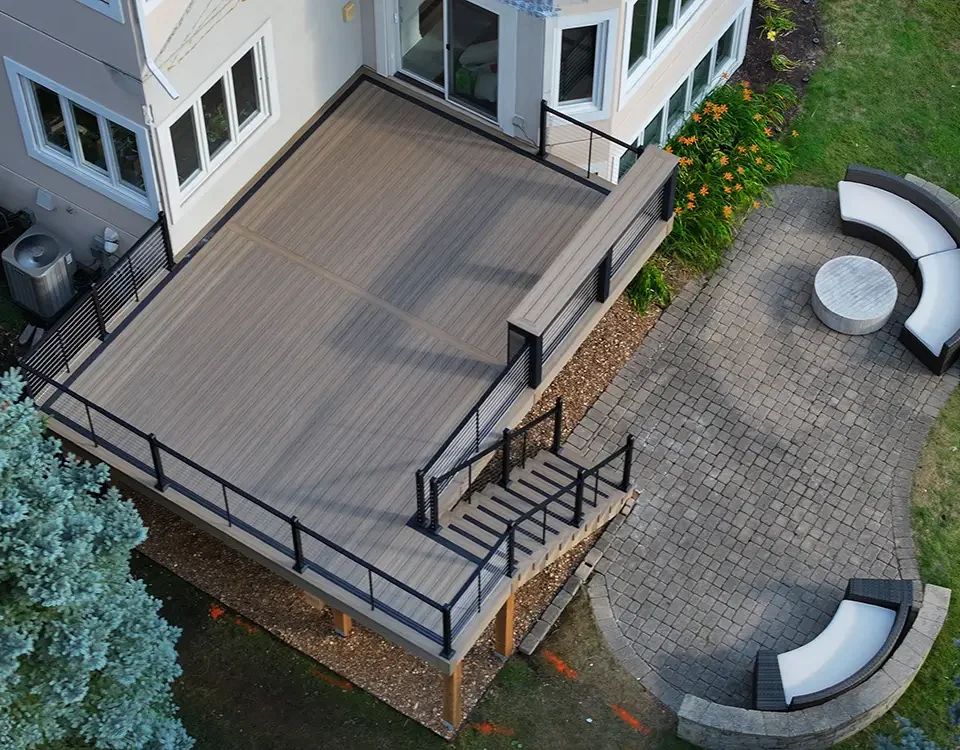
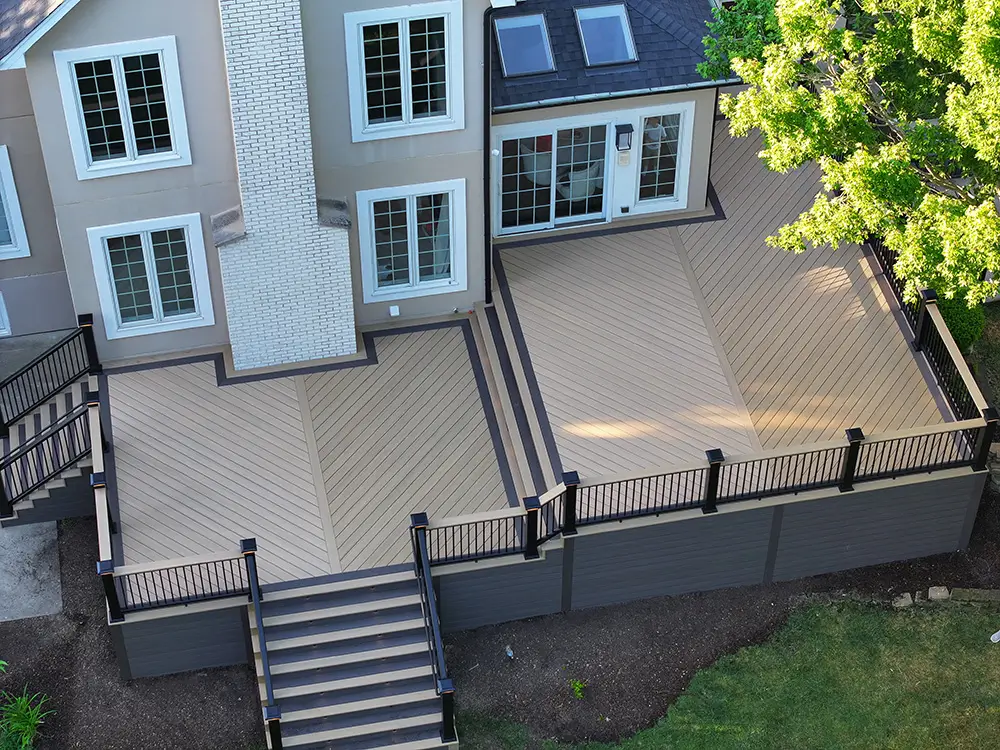
Board choice matters most in this zone. Around a plunge and under a sauna, we lean toward TimberTech AZEK PVC or Deckorators Voyage, because neither has wood fiber in its core to take on water. Capped wood composites do fine on the rest of the deck. The lines we carry are on our composite deck installation page.
People will walk this path barefoot and wet, so traction counts too. We bring physical board samples to every estimate. Pour some water on them and stand on them barefoot before you pick one. Our post on pool deck materials compares how different boards handle sanitizers and wet feet.
[Image 3]
Using a sauna and plunge through a Chicago-area winter
Plenty of owners keep using their plunge and sauna through the winter, and that’s when the water causes trouble. Drips around the tub freeze, and the path between the sauna and the plunge can turn into a sheet of ice. Put a drainable mat or grate at the plunge exit, keep that path short, and use only the ice melt your board manufacturer approves, since some products can damage the surface or affect the warranty.
Low-voltage deck lighting on the stairs and along the path makes the walk to a plunge after dark much safer. Winter evenings get dark early here, so you’ll probably use it more than you expect.
Electrical: plan it before the boards go down
A traditional sauna heater needs its own 240-volt circuit. A 6 kW heater typically runs on a 30 to 40 amp breaker, and an 8 kW heater usually lands at 40 to 50 amps. Those breakers are bigger than the heater’s actual draw because a sauna heater counts as a continuous load, and the circuit gets sized at 125 percent of it. The heater’s installation manual has the final word on breaker and wire size. On older homes with 100-amp service, have an electrician check panel capacity before you buy the sauna.
Cold plunge chillers mostly run on 120 volts, but they still need a dedicated circuit with GFCI protection. Some manufacturers specify 15 amps and others 20, and they warn against running a plunge off an extension cord.
We run conduit for both circuits during framing, the same way we handle deck lighting, so no cords show on the finished deck. The wiring itself is a licensed electrician’s job, and in Burr Ridge electrical additions need a permit.
Burr Ridge permits for a sauna or plunge deck
The Village of Burr Ridge requires a permit for new decks and deck replacements. It also keeps separate permit checklists for swimming pools and spas and for accessory buildings, so ask the Village which ones apply to your sauna and plunge before you submit. Applications go through the Village’s online portal. Initial reviews take up to 15 business days, and resubmittals take up to 10. Inspections happen on weekday mornings, and a failed inspection comes with a re-inspection fee. Starting work without a permit can bring a stop-work order plus a fine and fee that together start at $1,500. Current requirements and staff contacts are on the Village of Burr Ridge building permits page.
If your subdivision has an architectural review committee, get its approval before the Village submission. A sauna and a chimney are more visible than a deck on its own, and the committee will want to see both on the drawings. We pull deck permits ourselves and prepare the drawings and material specs for HOA submissions as part of the job.
Layout details that make the space easier to use
Keep the walk from the sauna door to the plunge down to a few steps, with a bench nearby for cooling off between rounds. Give the plunge shade if you can, because the chiller needs open air around it to shed heat and works harder with the tub in full afternoon sun. A hose bib within reach makes refills much less of a chore. On lots that back up to neighbors, look at the sight lines from their second-floor windows before you decide which way the sauna door faces.
Adding a sauna or plunge to a deck you already have
It can often be done, once someone has checked the framing. We look at joist size and spacing, the beam, the footings, and the ledger connection to the house. Many older decks were framed for wood boards and need reinforcement under the new load zone. That means pulling the boards in that area, adding joists, blocking, and footings, and then relaying the surface. Our post on composite joist spacing explains why older frames often fall short. If the deck is near the end of its life anyway, rebuilding that section is usually the better use of the money.
Frequently asked questions
Can a regular deck hold a barrel sauna?
Often, yes. A four-person barrel with people inside averages under 40 psf, within a standard deck’s 50 psf design load. The weight comes down through narrow cradles, so the cradles should cross the joists at a right angle with solid blocking underneath.
Can I put a cold plunge on my deck?
Only with reinforced framing. A filled single-person plunge with someone in it typically puts down 80 to more than 100 psf, well past what a standard deck is designed for. The plunge area needs its own framing and footings.
Will a sauna damage composite decking?
A correctly installed electric sauna rarely does. The usual causes of damage are water trapped under the sauna and embers or hot ash from a wood-fired stove. Composite warranties generally exclude heat damage.
Do I need a permit for a sauna deck in Burr Ridge?
Yes. The deck needs a building permit, and the electrical work needs one too. The Village also has separate checklists for pools and spas and for accessory buildings, so confirm with the Building Department which apply to your project.
Where should cold plunge water drain?
Away from the house and any window wells, through a hose route you plan before the deck is built. Check your sanitizer’s label before draining treated water into the yard.
What decking works best around a cold plunge?
Boards with no wood fiber in the core, such as PVC or mineral-based composite, with a deep texture for wet bare feet.
Planning a sauna or plunge deck in Burr Ridge?
We build decks across Burr Ridge and nearby Hinsdale, La Grange, Western Springs, Downers Grove, and Darien, and we plan the framing and wiring for a sauna or plunge at the first site visit. Bring the spec sheets for the models you’re considering, and we’ll tell you what the deck needs to carry them. You can read more about our deck work in Burr Ridge, request a free quote, or call (312) 765-3998.
Wolf Spirit Deck 1 Mid America Plaza, Floor 3, Suite 2302 Oakbrook Terrace, IL 60181 (312) 765-3998
About the author: Radu Oprea is the owner and CEO of Wolf Spirit Deck, which has built decks in Burr Ridge and across DuPage and Cook County for more than a decade under License #TGC119852.