By Radu Oprea, Owner, Wolf Spirit Deck · Illinois Contractor License #TGC119852 · Naperville, IL · Last updated: June 2026
A pool deck takes more abuse than a regular deck, and most homeowners don’t find that out until year two. You pick a material because you liked the color in the showroom, then a July afternoon hits, the kids are running back and forth from the water, and the boards you chose are either too hot to stand on or already going gray where the splash lands. I’ve replaced enough of these around Naperville to know which materials hold up next to a pool and which ones I’d talk you out of.
Here’s the honest version, based on what we actually see when we tear the bad ones out.
What attacks a pool deck in Naperville
Two things wreck pool decks here, and they work differently.
The first is water with chemistry in it. Splashout from a chlorinated pool, or worse, a saltwater pool, lands on the same spots over and over and never fully dries during a humid Naperville summer. That constant wet-then-dry cycle is hard on bare wood and brutal on cheap fasteners.
The second is sun. We get real heat from late June through August, and a pool deck sits out in the open with no tree cover most of the time. Dark boards soak that up. If you’ve ever hopped across a deck on your toes to reach the shade, you’ve felt the material fail in real time.
A good pool deck has to shrug off both. A lot of materials handle one and lose to the other.
Wood near a pool: where it works and where it doesn’t
I still build wood decks, just not usually right at the water’s edge.
Pressure-treated pine is the cheapest option on the rack, and it’s the one I see fail first by a pool. The repeated soaking opens up checks and cracks, the surface splinters, and pool splash speeds all of it up. Splinters and bare feet are a bad mix. If budget forces pine, it belongs on a deck away from the splash zone, not as the surface your kids sprint across.
Cedar is softer and prettier, and it feels good underfoot. The problem is upkeep. Chlorine and UV gray it out fast, and to keep it looking like the day we built it you’re sealing it every year or two. Right next to a pool, that maintenance window gets shorter, not longer.
Ipe and other tropical hardwoods are a different story. They’re dense, they handle water better than almost any wood, and they barely splinter. The catch is heat. A dark, dense board in direct sun gets hot enough that you’ll want sandals on a sunny afternoon. Ipe is also expensive and getting harder to source responsibly, so I only steer people toward it when they really want real wood and understand the tradeoffs.
Composite and PVC: the chlorine question
The question I get most often is whether pool chemicals eat composite decking. They don’t. The protective cap on a capped composite or a PVC board doesn’t care about chlorine or salt. That’s the whole reason these materials make sense around water.
There’s a real difference between the tiers, though, and it matters by a pool.
Mid-grade capped composites (the wood-plastic core lines) resist moisture well and won’t rot or splinter. They’re a solid pick for most pool decks. The thing to watch is heat, since the darker colors in these lines still warm up.
PVC and mineral-based boards (TimberTech AZEK and Deckorators mineral-based, for example) are what I lean toward for a pool deck when the budget allows. They absorb basically no water, so they won’t swell or cup from constant splash, and the lighter colors run noticeably cooler than dark composite. Salt water doesn’t bother the cap either, which becomes important if you have a saltwater system.
If you want the longer breakdown of how each material behaves in our climate, I wrote one here: what holds up best in a Naperville summer.
The heat problem nobody mentions until August
Color does more around a pool than anywhere else on your property, because this is the one deck people walk across barefoot all day.
Lighter boards stay cooler. Dark boards look great in photos and then cook in the sun. I’ve stood on a dark gray composite pool deck in early August that was genuinely uncomfortable on bare feet by 2 p.m., and the homeowners told me they’d basically stopped using it midday. We pulled it and went lighter.
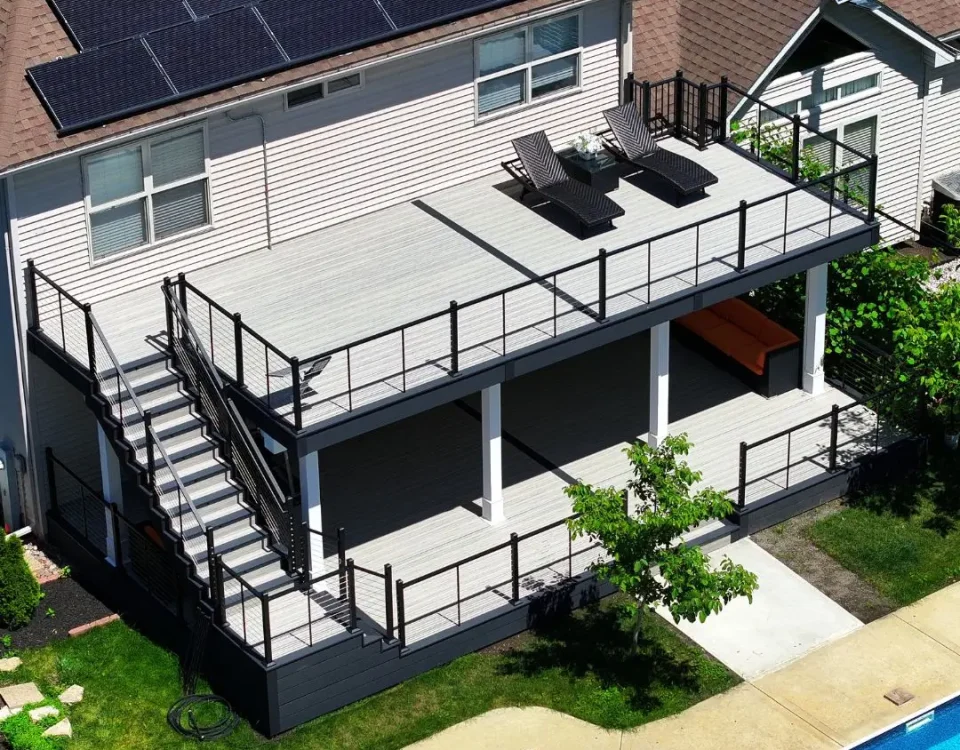
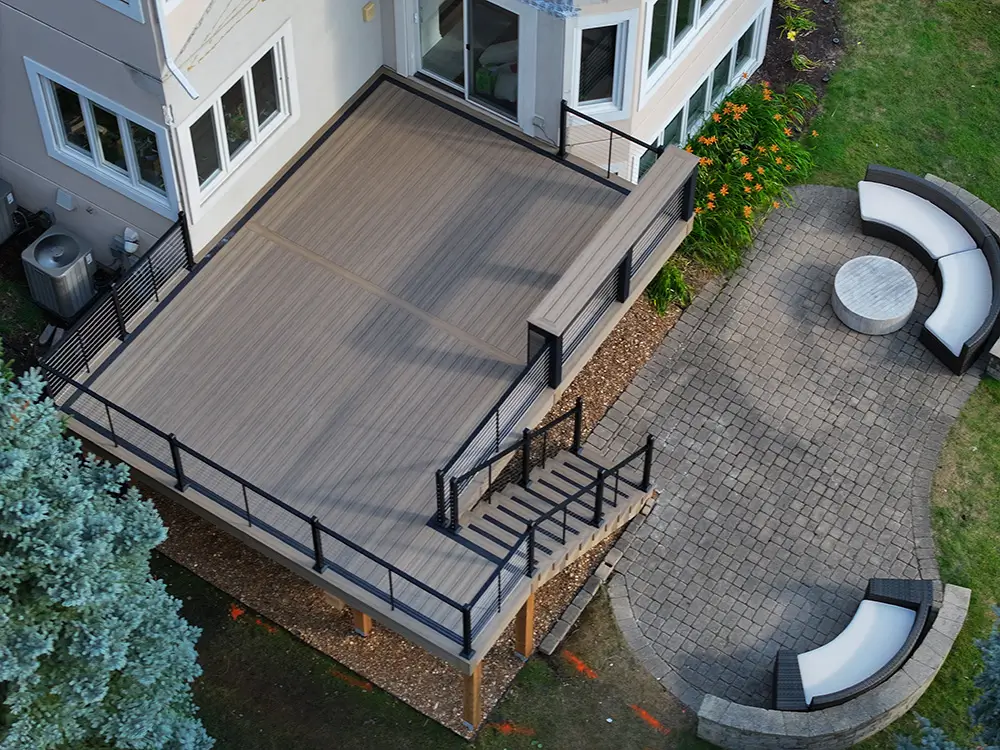
My usual move on a pool deck is a lighter field color where everyone walks, with a darker picture-frame border for contrast since nobody stands on the border for long. You get the look without turning the swim area into a hot plate. If you’re stuck on color choices, this walks through the tradeoffs: picking a composite color you’ll still like in five years.
Saltwater pools change the hardware math
Saltwater systems are easier on swimmers and harder on metal. The salt that makes the water feel nicer is the same salt that corrodes ordinary fasteners and hardware over time.
If you’re on a saltwater system, the boards are the easy part. The fasteners, hangers, post bases, and railing hardware are where I get picky. Near salt water I spec stainless steel, and on the framing connections I want coatings rated for that exposure, not the cheap box-store screws that rust through in a few winters. This is the kind of detail that doesn’t show up in a quote comparison, and it’s exactly the kind of detail that decides whether your deck is solid in ten years.
Slip resistance when the boards are wet
Every board feels fine dry in the showroom. The question by a pool is how it feels wet, with a kid running.
Smoother, glossier surfaces get slicker when water sits on them. The textured and lower-sheen lines hold traction better. I always bring samples out to the actual site and we wet them down so you can feel the difference before you commit, because a swatch under fluorescent light tells you nothing about a wet July deck.
What’s under the boards matters more by a pool
The ground around a pool is usually disturbed. When the pool went in, the soil got dug up, moved, and backfilled, and backfilled ground settles differently than undisturbed ground. That changes how I set footings, and on some Naperville lots it’s a good argument for helical piles instead of poured concrete so the deck doesn’t shift as the fill compacts.
Constant splash and standing water also mean the framing has to breathe and drain. We tape the joists, flash anything tying into the house, and leave the structure ventilated so water that lands on it can dry instead of sitting in the dark and rotting from the inside. You never see any of this once the boards go down, which is exactly why some builders skip it.
The barrier and railing code you can’t skip
A deck around a pool isn’t just a deck. It’s part of your pool’s safety barrier, and that comes with code you don’t get to negotiate.
The basics most Naperville-area jobs have to meet: a barrier at least 48 inches high, no gaps a small child can slip through, and self-closing, self-latching gates. The federal guidance behind almost every local rule is the Consumer Product Safety Commission’s safety barrier guidelines for home pools, and the City of Naperville builds its own requirements on top of that. We pull the permit and design the railing to pass, rather than building something pretty and finding out at inspection that it fails.
Railing choice ties into this too, since cable, aluminum, and composite each handle the code and the poolside view differently. I compared the real cost and code differences here: aluminum, composite, or cable railing for a Naperville deck.
What I usually build for a Naperville pool deck
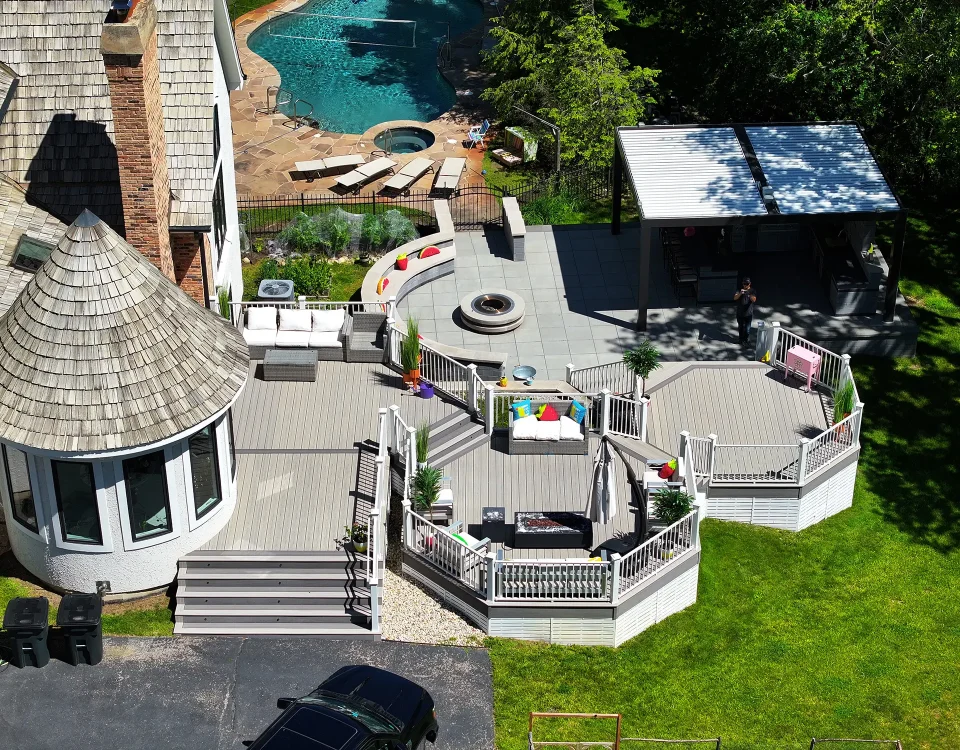
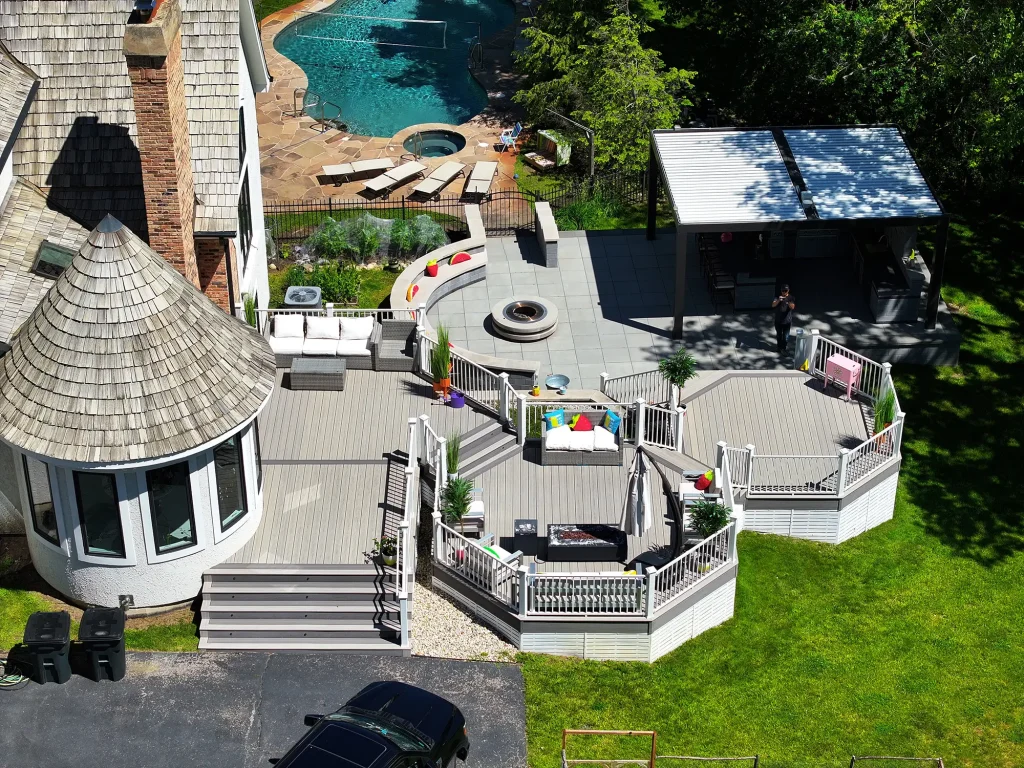
When a Naperville homeowner asks me to build right up to the water, my default is a lighter PVC or mineral-based board for the surface, stainless or properly coated hardware throughout, a textured line for wet traction, and a code-compliant barrier designed before we draw anything else. It costs more than a treated pine deck. Around a pool, it’s the version that’s still solid and still comfortable a decade later, which is the only version worth paying for.
If real wood matters more to you than low maintenance, I’ll build it. I’ll just be straight with you about the sealing schedule and where to keep the wood so the splash doesn’t win.
If you’re planning a pool deck anywhere around Naperville or the western suburbs, that’s exactly the work we do. You can see more on our Naperville deck building page or call the office at (312) 765-3998 for a free on-site look at your yard.
Frequently asked questions
Does chlorine or salt water damage composite decking? No. The cap on a capped composite or PVC board isn’t affected by chlorine or salt. The weak points around a pool are bare wood, which grays and splinters, and cheap fasteners, which corrode. Pick a capped board and good hardware and the pool chemistry is a non-issue.
Which pool deck material stays coolest in the sun? Lighter colors in PVC or mineral-based lines run the coolest underfoot. Dark composite and dense hardwood like ipe get the hottest. On a pool deck I usually put a light field color where people walk and save any dark tone for the border.
Do I need a permit and a fence for a pool deck in Naperville? Yes. A deck around a pool is part of the pool’s safety barrier, so it has to meet barrier code, generally a 48-inch height, no climbable gaps, and self-latching gates, on top of the standard City of Naperville deck permit. We handle the drawings, the permit, and the inspections.