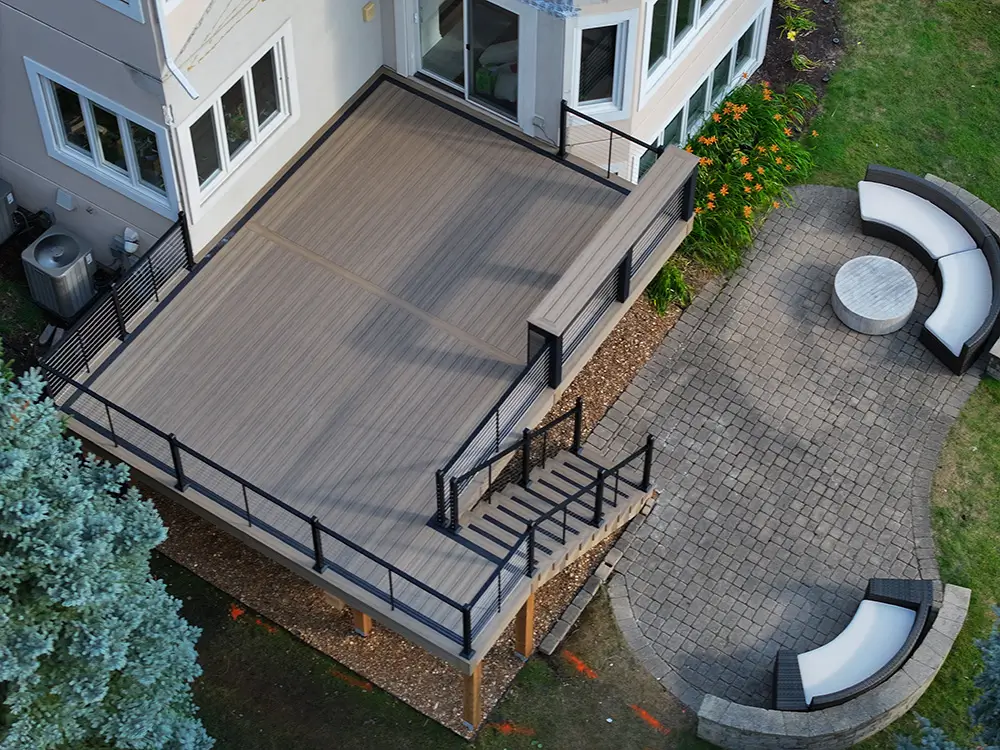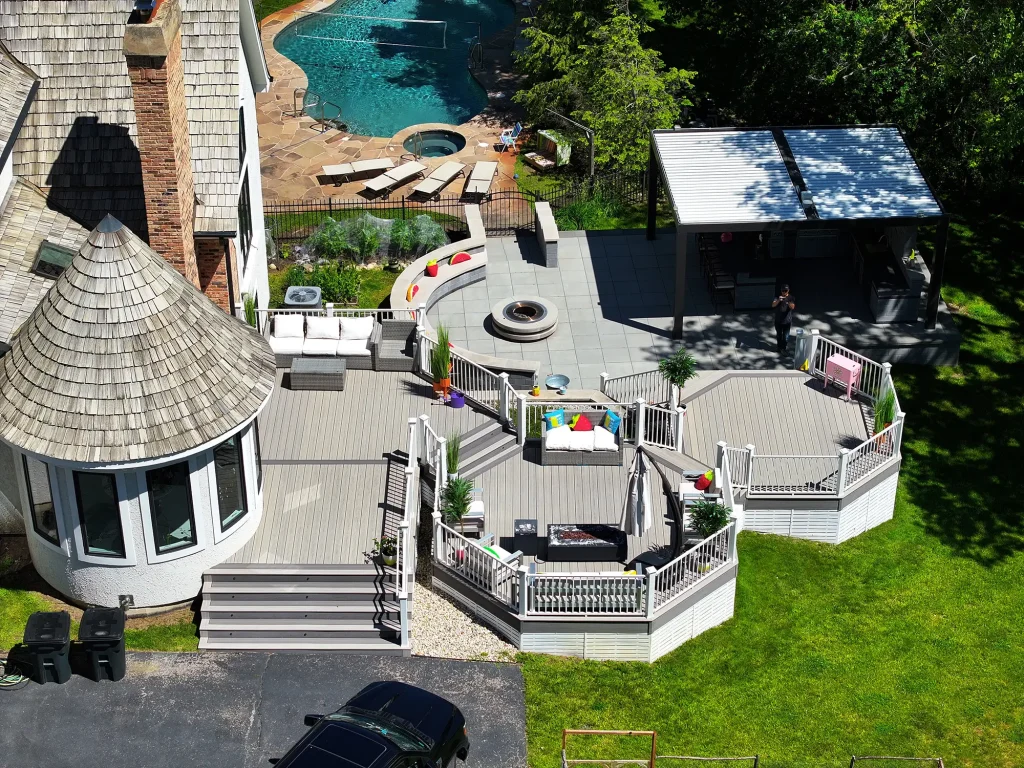
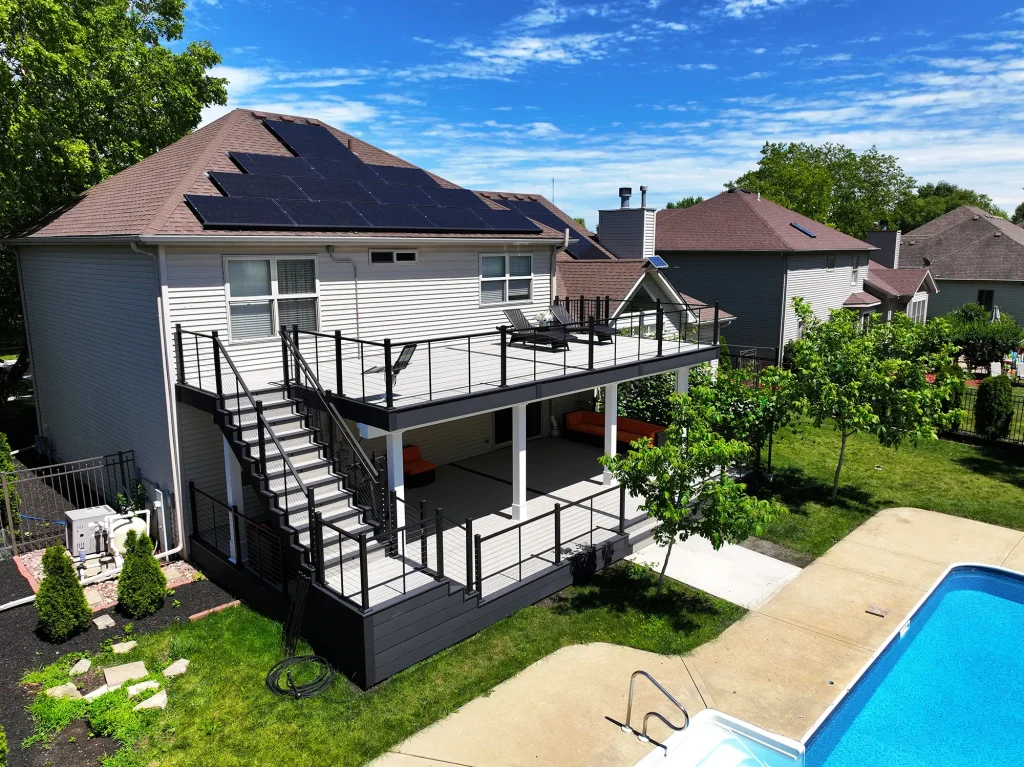
Railing gets picked from a showroom sample or a website photo, both of which are shot in full sun on a clean deck. Then it goes in under a hundred year old oak, and two seasons later the homeowner is annoyed with a product that would have been fine anywhere else in the yard.
Downers Grove has more of this problem than most towns. The Village has been a Tree City USA since 1984, holds Level 2 accreditation from the Morton Arboretum, and its forestry staff manage roughly 23,000 trees on public land alone. Add what is standing in private backyards and a lot of decks here spend the whole summer in dappled shade.
Shade is the reason people want the deck there. It is also the reason some railing systems age badly. Here is what actually happens, and what we specify when a deck sits under canopy.
Three things a tree does to a railing
It drops things on it, constantly. Not just leaves in October. Oak catkins and pollen in spring, acorns from late summer through fall, twigs after every storm, and bird droppings year round because a railing under a tree is directly under a perch. Maples and lindens add aphid honeydew, which is a sticky sugar coating that then grows sooty mold on top of itself.
It keeps everything damp. This is the part people underestimate. A deck in full sun dries within an hour of rain. A deck under dense canopy can stay wet most of the day, and in a Downers Grove spring it may not fully dry for a week. Organic debris plus permanent moisture is how you get the green biofilm that turns a top rail slick.
It stains. Oak leaves and acorns are loaded with tannins. Wet tannin sitting on a light coloured surface leaves brown marks that are not dirt and do not come off with a hose.
Everything below follows from those three.
The top rail matters more than the material
If you take one thing from this, take this.
Under a tree, the single most important decision is the profile of the horizontal surface people rest their hands on. A wide, flat, square top cap is a shelf. Debris lands on it and stays there. A narrower or crowned top rail sheds most of what falls on it and dries faster because more of its surface is exposed to air.
We have replaced perfectly sound composite railings for homeowners who were simply tired of wiping a four inch wide flat cap every weekend. The railing had not failed. It just collected things.
So before arguing about aluminum versus composite versus cable, look at the cross section of the top rail and ask whether an acorn would sit on it or roll off.
How each system behaves in shade
Aluminum is the default we recommend under canopy. Powder coated aluminum does not absorb water, does not feed mold, and does not stain from tannin. The top rails are usually narrower than composite, so they shed debris. It washes clean with a hose and a soft brush. The main caveat is that a scratch through powder coat on a cut end can corrode, so ends need to be properly capped and sealed at installation, which is an installer issue rather than a product issue.
Composite and PVC railing is fine, with one condition. The systems themselves handle moisture well. The problem is almost always the top cap profile and the colour. Wide flat caps in shade grow biofilm, and light greys and tans show tannin staining badly. If you want composite railing under a tree, pick a mid tone rather than a very light one and pick the narrowest cap the system offers. Our notes on choosing a composite colour apply to railing as much as decking, and the general composite upkeep guide covers the washing routine.
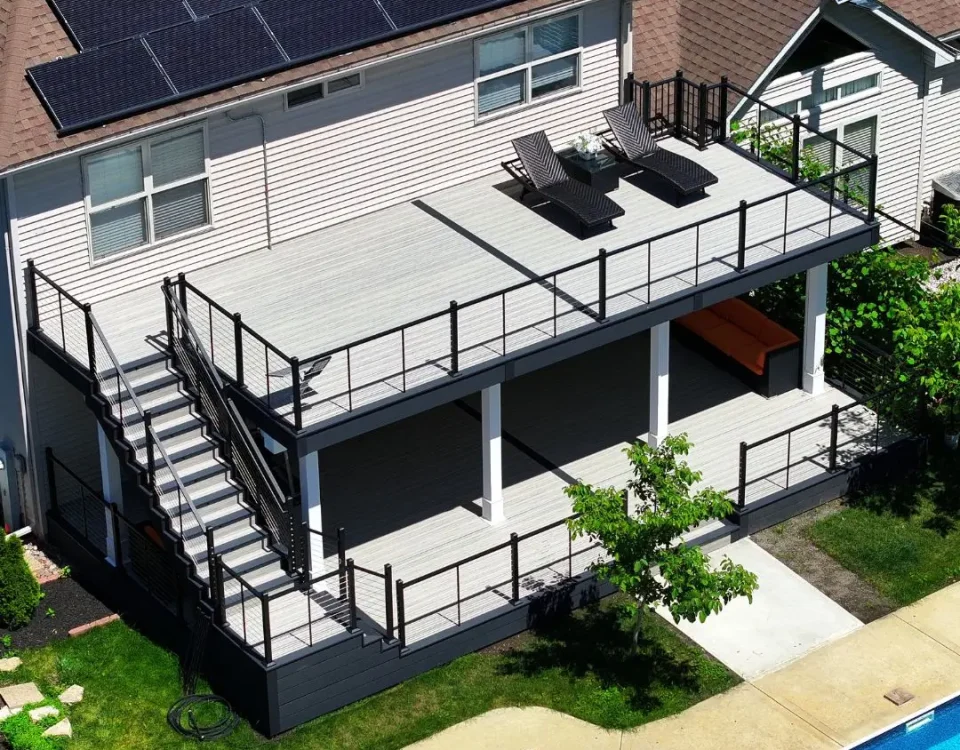
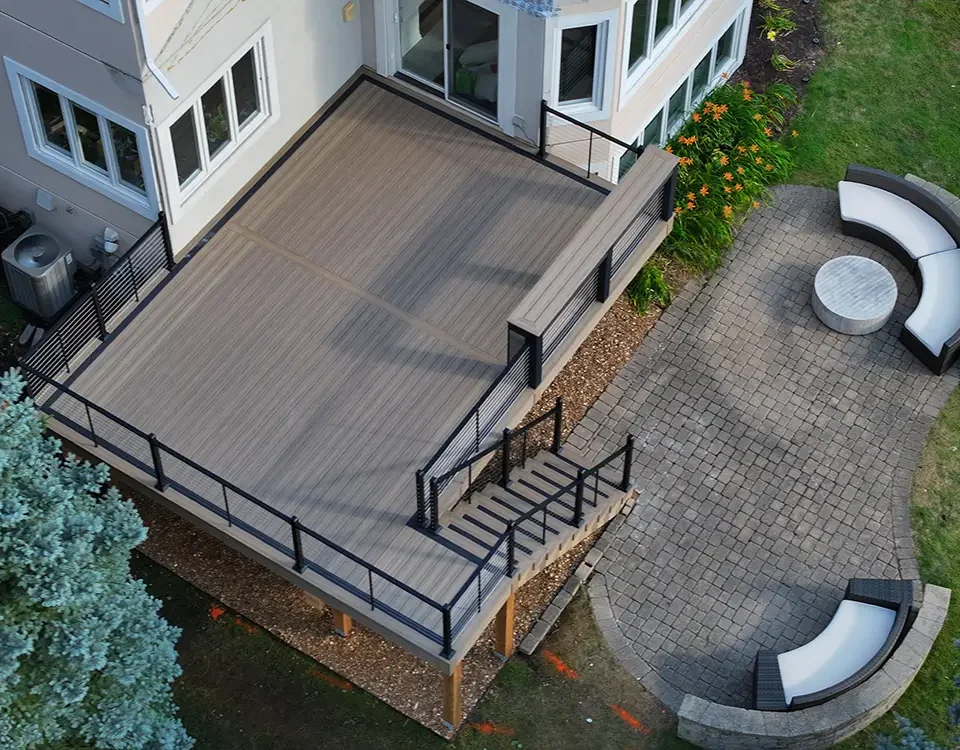
Cable railing looks great and is more work here than people expect. Horizontal cable is visually the right answer under a tree, because it disappears and lets you actually see the trunk and the canopy. That is a real benefit and it is why people ask for it.
The trade off is that you now have eight or ten horizontal lines across every span, and every one of them catches what falls. Cleaning cable railing means running a cloth along each cable individually. Under an oak, several times a season. Stainless cable also picks up tannin staining, and while it is cosmetic rather than structural, it is visible on a bright finish. Specify 316 stainless rather than 304 if the budget allows, and expect to re-tension cables in the first year as they settle.
We install cable railing regularly and we are happy to build it. We just tell people the maintenance reality first, because the ones who are unhappy later are the ones who were sold the look without the chore.
Glass panels are the wrong choice under a tree. Full height glass in shade is a permanent spotting problem. Rain does not clean it, it just redistributes what is already there, and pollen plus honeydew plus bird droppings on glass is visible from inside the house. If you want the view through the railing, cable is the better version of that idea in this situation.
Wood railing is the hardest to keep under canopy. Wood in permanent shade stays wet, and wet wood grows mildew and eventually rots, starting at the joints and the tops of posts where water sits. The deeper problem is refinishing. Stain and sealer need dry wood and a dry forecast, and getting a genuinely dry window under dense canopy in Downers Grove is difficult. A wood railing that should be refinished every two or three years often is not, and then it fails early.
If you want the warmth of wood, a composite or aluminum system with a wood grain finish gets you most of the look without the refinishing cycle you will not keep up with.
Hardware corrodes faster than the railing does
The part nobody quotes on and everybody eventually notices.
Tannins are mildly acidic. Constant damp plus mild acid plus cheap fasteners equals rust streaks running down your posts within a few seasons. On a light railing those streaks are permanent.
Under canopy we use stainless throughout rather than coated carbon steel, including the screws nobody will ever see. It is a small material cost against the price of a railing, and it is the difference between a system that looks new in year six and one that looks neglected. The same logic applies to the deck surface fasteners, which we covered in our comparison of three real deck quotes.
Post caps matter here too. An open or poorly sealed post top under a tree collects water and debris in the post cavity, and that is where hidden corrosion starts.
Falling limbs are a real load case
Mature oaks and silver maples drop limbs. Silver maples especially, which are common in the older Downers Grove neighbourhoods and are structurally weak by species.
Code sizes a guard to resist a 200 pound concentrated load applied by a person, not a falling branch. Nothing you install will survive a large limb. But there is a meaningful difference in what happens with a small one.
Aluminum and composite systems tend to damage locally, so you replace a section. Glass panels shatter and the whole panel is replaced, which is expensive and sometimes a long lead time. Cable systems can have a single cable pushed out of line, which is usually re-tensionable rather than a replacement.
If your deck sits directly under heavy limbs, ask your builder whether the system you are choosing can be repaired in sections, and whether the manufacturer still makes it. A discontinued railing with a broken panel is a much bigger problem than a current one.
The code baseline, briefly
Downers Grove has adopted the 2021 International Residential Code with Village amendments. In general terms that means a guard is required where the walking surface is more than 30 inches above grade, residential guard height is a minimum of 36 inches, and openings must not allow a 4 inch sphere to pass through.
Cable railing is where that last rule bites. Cables stretch, and a system that passes at installation can fail the sphere test later if it is not tensioned properly or if intermediate posts are spaced too far apart. That is a design decision made before the permit, not a fix applied afterward.
We are not going to re-run the full cost and code comparison here, because we already did it in aluminum, composite or cable railing: cost and code compared. This post is about what shade does to those systems once they are installed.
Lighting changes the calculation
One thing worth planning at the same time. Under dense canopy a deck goes dark earlier in the evening than an open one, sometimes by an hour. Railing systems differ a lot in how well they accept integrated lighting, and retrofitting light into a railing that was not designed for it is awkward.
If your deck is shaded, decide about under rail and post cap lighting before you pick the railing rather than after. We went through the options in under rail and in deck lighting for multi level decks, and there is more on our deck lighting page.
Frequently asked questions
What is the best deck railing for a shady, tree covered yard? Powder coated aluminum, in most cases. It does not absorb moisture, does not stain from tannin, has a narrower top rail than most composite systems so it sheds debris, and cleans with a hose. Composite works well too if you choose a narrow top cap and a mid tone colour rather than a very light one.
Is cable railing a bad idea under trees? Not bad, just higher maintenance. Cable is visually the best choice for keeping a view of the trees, but each cable catches falling debris and has to be wiped individually. Specify 316 stainless and expect to re-tension in the first year.
Why does my composite railing look green? That is biofilm, and it grows on any surface that stays damp. Under canopy a deck may not dry out for days. It washes off, but a wide flat top cap will keep growing it. A narrower profile and better airflow reduce how often you deal with it.
Do oak trees stain deck railings? Yes. Oak leaves and acorns contain tannins, and wet tannin sitting on a light surface leaves brown marks that a hose will not remove. Mid tone colours hide it far better than pale greys and tans.
How high does a deck railing have to be in Downers Grove? Downers Grove uses the 2021 IRC with Village amendments. In broad terms, a guard is required above 30 inches from grade, the minimum residential height is 36 inches, and openings cannot pass a 4 inch sphere. Confirm current requirements with Community Development at 630-434-5515 before finalizing a design.
Does the Village restrict what railing I can install? Not by material. What gets reviewed is whether the guard meets code. Homes in a historic district may face additional design review.
Building under the canopy
The trees are why the deck is worth building. Nobody should give up an oak to get an easier railing.
What is worth doing is matching the system to the conditions rather than to a showroom photo. Narrow top rail, mid tone colour, stainless hardware, and a design that can be repaired in sections. Get those four right and a shaded deck stays looking good with a hose and twenty minutes a season.
If you want to see how your own street compares, the Morton Arboretum publishes a tree canopy summary for Downers Grove alongside every other community in the region. It is a useful reality check on how much canopy you are actually building under.
Wolf Spirit Deck builds throughout Downers Grove and the western suburbs. See our Downers Grove deck builders page, or read our post on Downers Grove tree rules and deck footings if you are building near a large tree.
To walk a shaded lot with us, request a free quote or call (312) 765-3998.