By Radu Oprea, Owner, Wolf Spirit Deck. Illinois Contractor License #TGC119852. Naperville office: 2020 Calamos Ct, Suite 200. Published August 2026.
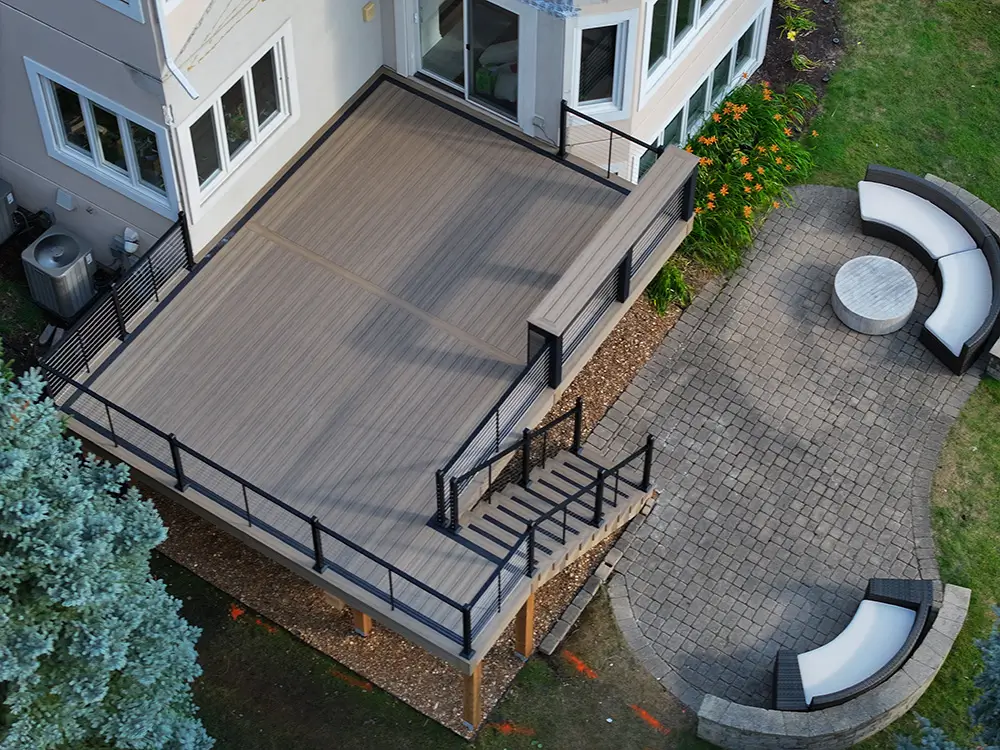
A homeowner south of 63rd called us in June about a 16 by 20 deck off the back of her house. Nice flat yard, mature yard, no drama. Then she mentioned that the low corner near the fence turns into a pond every spring and takes about four days to drain.
That one sentence changed the whole project. Not the design. The paperwork, the footings, and about six weeks of schedule.
Here is the thing most people get wrong about building near water in Downers Grove. They assume the question is whether they are in the FEMA floodplain. If the answer is no, they figure they are clear. In this Village, that assumption is wrong often enough that I now check the map before I quote anything on the south or west side of town.
The word that matters here is LPDA
Downers Grove has roughly 12 miles of creeks running through it, split across three watersheds: Lacey Creek, St. Joseph Creek, and Prentiss Creek. All three drain to the East Branch of the DuPage River. If you live near any of them, you already know what a heavy August storm looks like in your backyard.
But the Village regulates a second category that has nothing to do with FEMA. It is called an LPDA, short for Localized Poor Drainage Area. The Village’s own description is refreshingly plain: these are bowl-shaped pieces of land where runoff collects because it has nowhere to go. FEMA does not recognize LPDAs. Downers Grove regulates them almost exactly the way it regulates floodplain.
That is the trap. You can be a half mile from Prentiss Creek, nowhere near a blue line on a federal map, and still sit in a mapped LPDA that triggers the same review. I have seen homeowners find this out at the permit counter after they already signed a contract with somebody.
Check the map before you call a contractor
The Village publishes a tool called Parcel Navigator that will answer this in about ninety seconds. Search your address, open the Layers list at the bottom of the screen, and switch on the Utility layer. Floodplain and LPDA boundaries appear over your parcel. If the Utility text is greyed out, you are zoomed too far out.
Two honest cautions. The Village says outright that this map is not definitive proof either way, and it is right. Boundaries drawn at parcel scale get fuzzy at the edges, and I have had two jobs where the line ran through the middle of the proposed deck. When it is close, call Public Works at 630-434-5460 or email [email protected] and ask them to look at it. They answer. The full rules and the map instructions live on the Village of Downers Grove stormwater FAQ page, which is worth ten minutes of your time before you talk to anybody about a deck.
The second caution: wetlands. Any development proposed within 100 feet of a wetland may require its own construction permit with the Village, and possibly state and federal review, a delineation, and an impact study. That is a different animal from a deck permit and a much longer timeline.
Yes, a deck counts as a permanent structure
People push back on this one. It is just a deck, it sits on posts, water flows right under it.
Village code does not care. Any permanent structure placed in a floodplain or LPDA requires a permit. The code language specifically calls out swing sets and playground equipment, which tells you how broadly the Village reads the word permanent. Chapter 26, Section 1303 covers development standards in floodplain and LPDA. Section 505 covers building protection, including lowest opening elevations.
I mention Section 505 because it catches people doing more than a deck. If your project includes a walkout door, a roofed structure, or anything that changes an opening in the house, the elevation rules come into play and the conversation gets longer.
What I will not do is quote you a freeboard number in a blog post. Elevation requirements depend on the base flood elevation for your specific parcel, and I would rather you get that from the Stormwater Administrator than from me. Ask for it in writing.
What water does to a footing that frost never would
Standard practice in DuPage County is a footing at 42 inches for frost. On a normal lot that is the whole conversation. Near a creek it is the starting point.
Three things change.
Saturated soil holds less. A footing sized for firm clay behaves differently when that clay spends part of every spring holding water. The bearing capacity drops, and a pier that would have been fine at 12 inches of diameter wants to be wider. This is not exotic engineering. It is just sizing for the soil you actually have instead of the soil you wish you had.
Creeks move sideways. Everybody thinks about vertical scour. The bigger risk on St. Joseph Creek is lateral bank erosion, which is exactly why the Village runs a streambank stabilization program and completed a corridor assessment on St. Joseph back in 2015. A bank that has crept two feet toward the house over fifteen years will keep creeping. Setting a post line close to an actively eroding bank is a decision you get to regret slowly. I want distance, and where I cannot get distance, I want the structure designed so that losing a foot of bank does not threaten it.
Water lifts things. Floodplain rules generally require that structures resist flotation and lateral movement, and a deck with a lot of surface area and not much weight is more buoyant than it looks. Proper anchoring of post to footing matters more here than on a dry lot.
How we actually build these
Poured concrete piers, oversized and belled, are still the default. We go past 42 inches when the soil report or the hole itself tells us to, and we widen the base rather than just going deeper. Deeper is not automatically better in saturated ground.
Helical piles are the tool I reach for when the yard is soft, when access is bad, or when we are close enough to a bank that I want load transferred well below the disturbed zone. They cost more per point. They also do not require an open hole in wet ground, which on some of these lots is the difference between building in April and waiting until July.
Steel framing has quietly become my preference for low decks on damp lots. Wood framing eight inches off perpetually wet ground has a shelf life no matter how well you detail it. Steel deck framing does not care. It costs more up front and it is the single upgrade I have never had a client regret on a creek lot.
The fill trap
Here is where I watch the most money get wasted.
Somebody decides the real fix is to raise the low corner. Truck in soil, level the yard, build a normal deck on normal footings. Clean, simple, and in a mapped floodplain or LPDA it is regulated, because the volume you fill is volume that water used to occupy. The Village regulates LPDA construction specifically so new structures do not worsen existing problems, and grading a bowl flat is the textbook version of worsening it.
If you already have fill in the yard from a previous owner, that is a conversation to have with the Village early rather than late. Undocumented fill in an LPDA has stalled permits I have been involved in.
The better answer is almost always to build over the wet spot instead of eliminating it. An open deck with gaps between boards lets water pass. That is the design that gets approved.
What this adds to the price
I am not going to give you a number that pretends to be your number. But the pattern is consistent enough to describe.
Footings on a creek lot run two to three times what they run on a dry interior lot, because there are more of them, they are bigger, and sometimes they are helical. Permit review takes longer, and I plan for weeks rather than days when floodplain or LPDA review is involved. Access is often worse, since the wet corner is usually the corner you would have staged material in.
Against that, the deck itself is the same deck. Boards, railing, and stairs price out the way they always do. If you want the general ranges before we get specific, I wrote them up in what a deck actually costs in Downers Grove in 2026.
One more thing worth knowing, and it is good news for once. Downers Grove holds a Class 5 rating in FEMA’s Community Rating System, which earns property owners and renters here a 25 percent reduction on National Flood Insurance Program premiums. That is a real discount and a lot of people near these creeks do not know they qualify.
Hardware, boards, and the wet-ground problem
Everything within a couple of feet of soil that stays damp needs to be specified for it. Ground-contact rated treated lumber for anything close to grade. Hot-dipped galvanized or stainless hardware, because modern treated lumber chemistry eats cheap fasteners and the failure happens where you cannot see it.
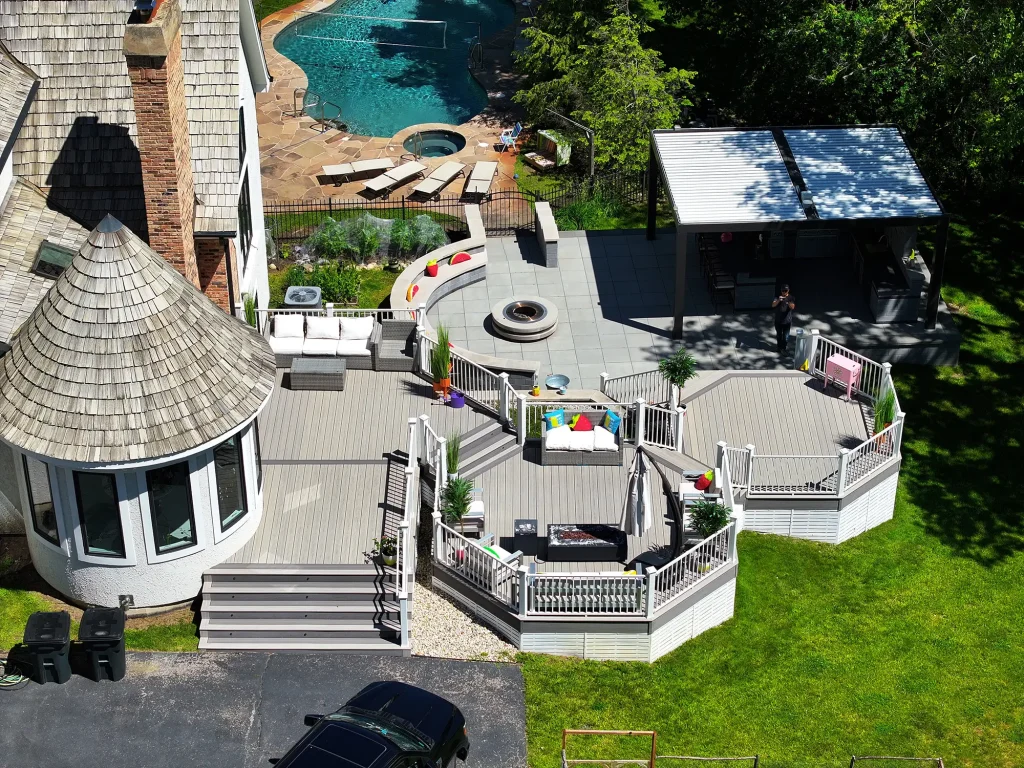
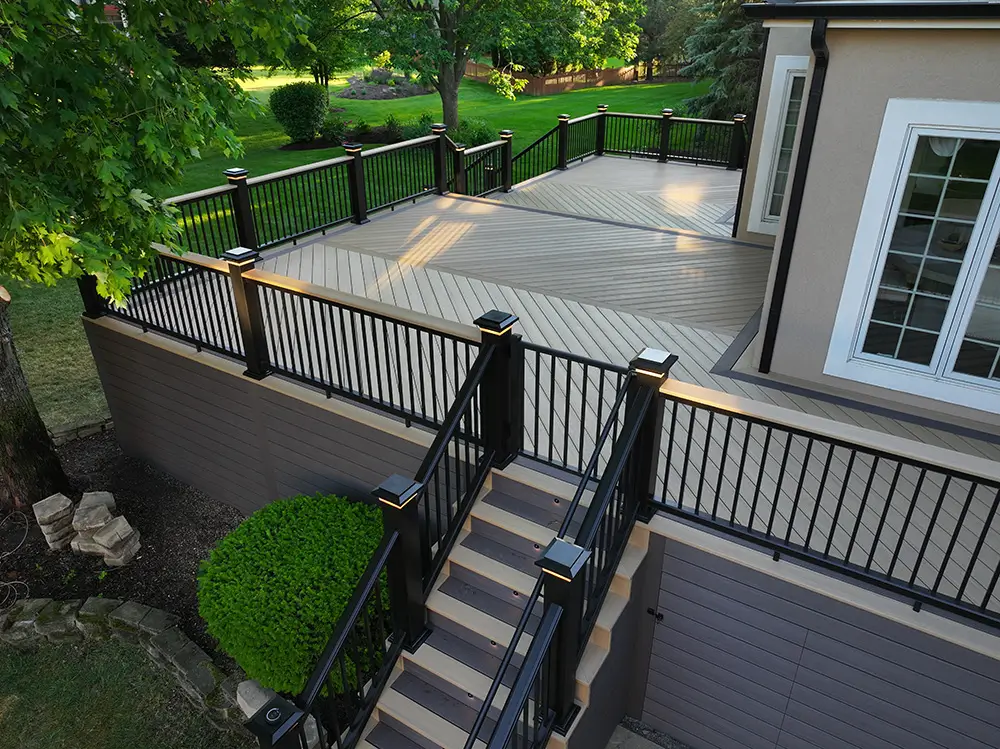
Composite decking handles the moisture itself fine. What it does not love is sitting in mud splash with no airflow underneath, which shows up as staining on the underside and eventually as a mildew problem on the surface. Height and ventilation solve it. On a low deck over a wet spot, I would rather lose two inches of headroom and gain airflow. If you are weighing materials, composite decking is the direction most of our creek-lot clients land, for reasons that have more to do with maintenance access than looks. Getting under a low deck to seal wood every other year is miserable work.
If your deck is already there
Different problem, and worth checking this fall. Pull back the mulch at two or three post bases and look at where post meets footing. On creek lots that connection is where things go first. Soft wood, rust bleed, or a post that has shifted off center are all worth a phone call.
Sometimes the frame is fine and only the surface is tired, in which case deck resurfacing is the cheaper path. Sometimes the footings have moved and resurfacing would be putting new boards on a compromised structure. I would rather tell you the second thing early than discover it halfway through.
Questions we get on these lots
Does an open deck really need floodplain review if water can pass under it? Yes. The Village treats a deck as a permanent structure, and permanent structures in a floodplain or LPDA require a permit regardless of how open the design is. Passing the review is usually straightforward. Skipping it is not.
My property is not in the FEMA floodplain. Am I clear? Not necessarily. LPDAs sit outside FEMA mapping entirely and are regulated by the Village under its own code. Check the Parcel Navigator Utility layer for both boundaries.
Will building a deck raise my flood insurance? An open deck on piers is a different question from finished living space, and it is one for your insurance agent rather than your deck builder. Ask before you build, not after.
How far from the creek do we have to stay? There is no single number I can give you, because it depends on the mapped boundary, the bank condition, and whether wetlands are involved within 100 feet. On an actively eroding bank I want more distance than code alone might require.
How long does the permit take with floodplain review? Longer than a standard deck permit. Plan for it and start earlier in the season than you think you need to.
Where to start
Pull up your address on Parcel Navigator and turn on the Utility layer. That single step tells you whether this is a normal deck project or a creek-lot deck project, and it costs you nothing.
Then call somebody who has done both. We build across Downers Grove, Lisle, Darien, and the rest of the western suburbs, and creek lots in 60515, 60516, and 60517 are a regular part of the work rather than a novelty. If you want a walk-through of your specific yard, our deck contractors in Downers Grove will look at the map with you before anyone talks about board colors, or you can request a free quote and we will start there.
Related reading: Downers Grove tree rules and deck footings covers the other thing that moves post locations in this Village, and railing choices under mature tree canopy is worth reading if your wet corner is also a shady one.
Radu Oprea has built decks across DuPage and Will County for over a decade. Wolf Spirit Deck holds Illinois Contractor License #TGC119852 and is a certified installer for TimberTech and Deckorators. Naperville office: 2020 Calamos Ct, Suite 200, Naperville, IL 60563. Phone: (312) 765-3998. This post describes our field practice and points to Village of Downers Grove code and staff for anything binding. Confirm current requirements with the Village before you build.